No written limits means guesswork
Every decision gets escalated by default, or approved with no real check.
Volume 11, Chapter 4
"Who can approve this?" should never be answered by guessing or asking around. Every role needs a written limit.
A written approval ladder removes the ambiguity that lets fraud find an opening, and removes the daily friction of every small decision needing the owner personally.
Every decision gets escalated by default, or approved with no real check.
A limit set years ago may now be too small or too generous.
If the owner routinely approves things outside it, the limits stop functioning as a control.
The same ladder applies to all three, always paired with segregation of duties.
Imagine a receptionist facing an unhappy customer with two bad options: refuse every refund request outright, annoying customers with genuine complaints, or grant them inconsistently, risking abuse from the rest. Neither is really her fault, nobody ever told her what she was actually allowed to decide on her own. A single written line, "reception can approve refunds up to ₦15,000 without passing it up," fixes both problems in one move: small legitimate complaints get resolved instantly, and anything larger gets the scrutiny it deserves.
is a written limit on how much any given role can decide to spend, refund, or purchase alone, before a higher level of sign-off is required. It is Volume 06, Chapter 1's authority-matching principle turned into an explicit number, for every role that touches money.
"Who can approve this?" should never be answered by guessing or asking around. A written approval ladder says exactly what each role can approve alone, up to what amount. This removes the ambiguity that Chapter 1's fraud triangle calls "opportunity," and removes the daily friction of every small decision needing the owner personally.
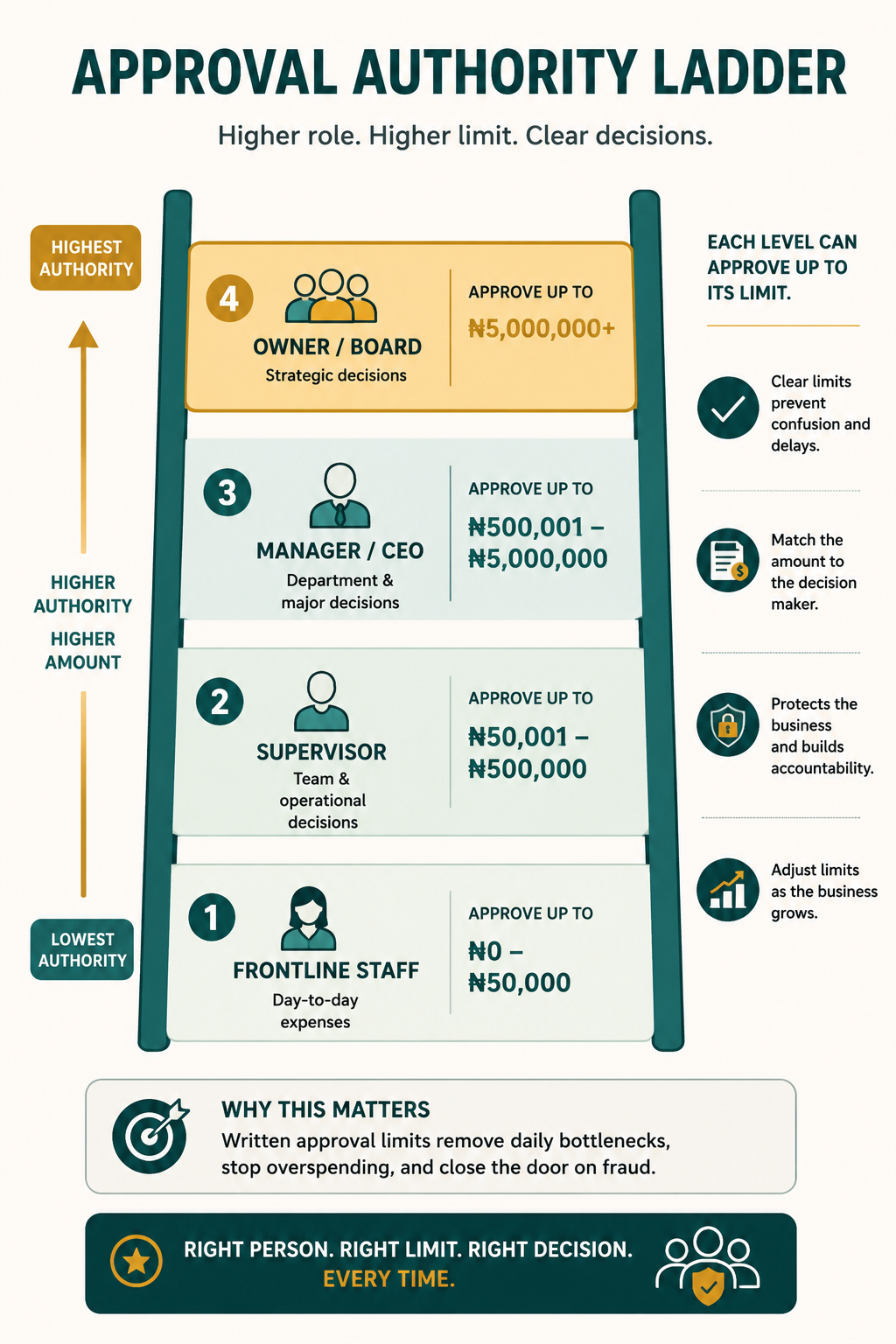
A small, fixed amount (e.g., ₦10,000). Applies to minor customer goodwill, small supplies.
A moderate amount (e.g., ₦100,000). Applies to routine departmental purchases.
A larger amount (e.g., ₦1,000,000). Applies to significant operational spending.
Above the manager limit, or any reserved matter (a big decision kept for the owners). Applies to major purchases, new debt, strategic spending.
| Level | Typical Limit | Applies To |
|---|---|---|
| Frontline staff | A small, fixed amount (e.g., ₦10,000) | Minor customer goodwill, small supplies |
| Supervisor | A moderate amount (e.g., ₦100,000) | Routine departmental purchases, Volume 06, Chapter 4's daily calls |
| Manager/CEO | A larger amount (e.g., ₦1,000,000) | Significant operational spending |
| Owner/Board | Above the manager limit, or any reserved matter | Major purchases, new debt, strategic spending |
The exact naira amounts are a policy decision for each business. What matters structurally is that every level has a real, written ceiling, and nothing above it can be approved alone.
Ready-to-use version: Approval Authority Matrix
| Decision Type | Segregation Applied |
|---|---|
| Expenses | Approved against the ladder; paid by someone other than the approver where possible (Chapter 2) |
| Refunds | A frontline limit for small, obvious cases; anything larger goes up a level. This prevents both poor customer service and refund abuse |
| Purchases | Follows the purchase triangle: ordering authority is capped by the ladder; receiving and paying stay segregated regardless of amount |
Here's the full version of the refund story from the start of this chapter.
Before a written refund policy existed, reception staff at MANIAC MINDZ either refused all refund requests (annoying genuine customers) or granted them inconsistently (risking abuse), because no one had ever defined what they were actually allowed to do. A simple rule fixed both problems at once: reception can approve refunds up to ₦15,000 without passing it up; anything above requires a supervisor. Legitimate small complaints were resolved instantly, and larger requests received the scrutiny they deserved.
| Business | An Approval Ladder Decision |
|---|---|
| City Kitchen | A server's authority to give away one free dish versus a manager's authority to waive a whole table's bill |
| Rapid Auto Works | A mechanic's authority to approve a minor extra repair versus a manager's authority for major additional work |
| Nimbus Labs | A support agent's refund authority versus a manager's authority to adjust a large business customer's account |
Forces every decision to be guessed or escalated by default, see the refund story.
A ₦10,000 frontline limit set five years ago may now be trivially small or, in an inflationary environment, oddly generous. Review it periodically.
If the owner regularly approves things "just this once" outside the ladder, the ladder stops meaning anything.
Using the Approval Authority Matrix, write a specific spending, refund, and purchase limit for every role in your business.