Blame lands on the powerless
A cashier can be responsible for the till without ever having authority to refuse a suspicious note.
Volume 06, Chapter 1
Responsibility asks "did it happen?" Authority asks "who could have changed it?" A healthy role always answers both questions with the same name.
Imagine a receptionist is told she is "responsible for customer satisfaction." A wedding order arrives two days late because of a fabric delay she never caused and never knew about until the angry phone call. She takes the blame anyway, because she answered the phone. But she was never given the power to expedite an order, adjust the queue, or offer any kind of fix. She was set up to fail the moment the job title was written.
is what you are expected to get done. Authority is what you are actually allowed to decide. The two sound like the same thing and are not, and almost every workplace conflict in a small business traces back to someone holding one without the other.
Being "responsible" for something means you're expected to make sure it happens. Having "authority" over something means you're allowed to make decisions about it. A cashier can be responsible for the till balancing at the end of the day without ever having the authority to refuse a customer's suspicious ₦50,000 note, and that gap is exactly where blame lands on people who never had the power to prevent the problem.
Imagine being told: "You are responsible for getting this car to Abuja by 6 p.m.", but someone else holds the steering wheel, chooses the route, and controls the fuel budget.
You are answerable for an outcome you cannot actually steer. If the car arrives late, you take the blame; if you point out you never had the wheel, that's not an excuse, it's a diagnosis. Responsibility without authority is being handed a destination with no way to steer toward it.
Flip it around: hand someone the steering wheel with no destination and no consequence for where they end up, and you get the opposite failure, someone empowered to decide things nobody is holding them accountable for.
Responsibility asks "did it happen?" Authority asks "who could have changed it?" A healthy role always answers both questions with the same name.
High responsibility, low authority. Blamed for outcomes with no power to shape them.
Fix by adding authorityHigh responsibility, high authority. Owns the outcome and holds the tools to influence it.
The healthy combinationLow responsibility, low authority. Follows clear instructions on a narrow, well-defined task.
Simple and stableLow responsibility, high authority. Can decide, but answers for nothing if it goes wrong.
Fix by adding accountability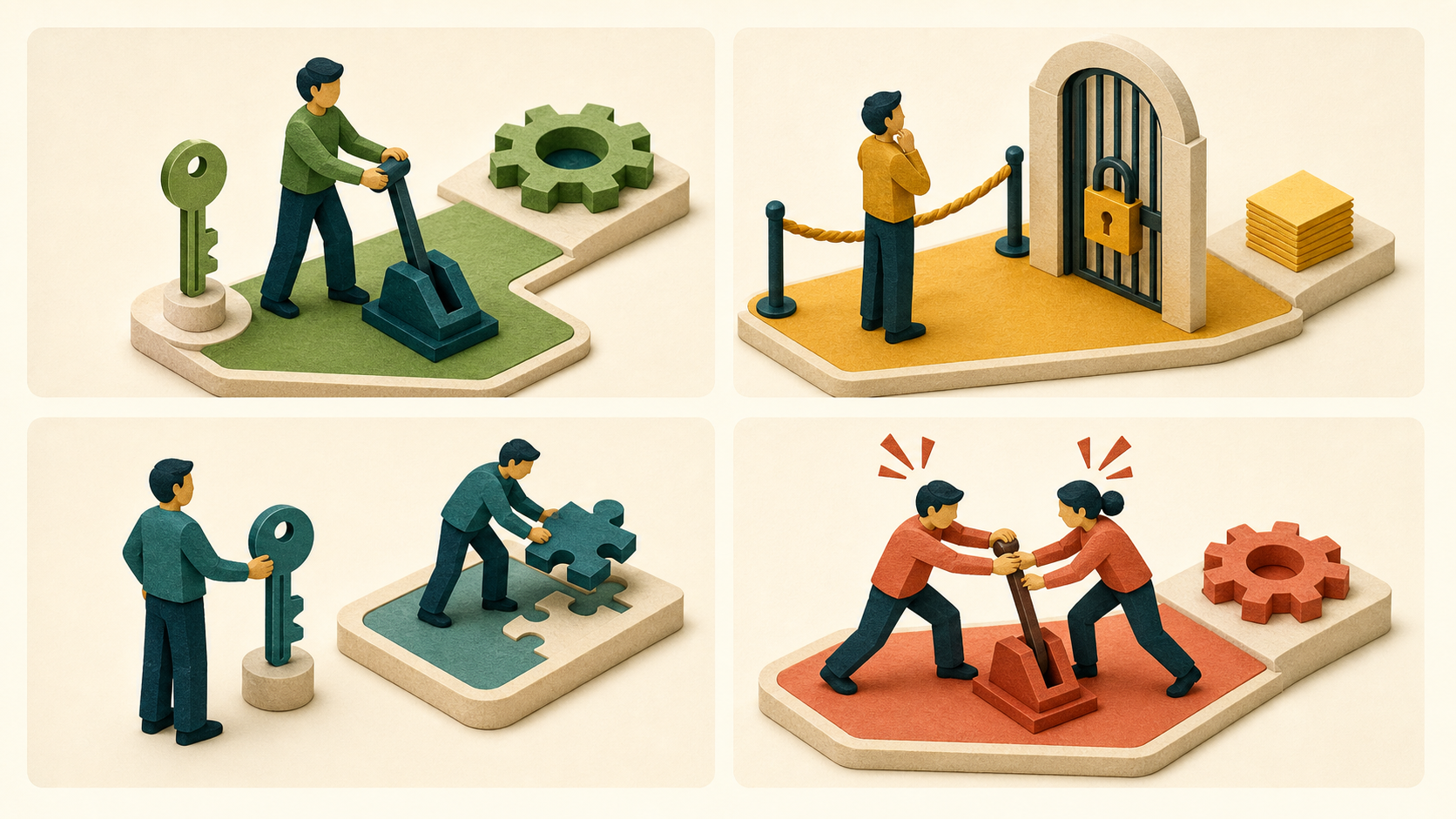
| Quadrant | What It Looks Like | Business Example |
|---|---|---|
| The Danger Zone (high responsibility, low authority) | Blamed for outcomes with no power to shape them | A cutter "responsible" for fabric waste, but has no say over which supplier's low-quality fabric he's given |
| The Sweet Spot (high responsibility, high authority) | Owns the outcome and holds the tools to influence it | A Production Supervisor who sets the daily schedule they're judged on |
| The Task Role (low responsibility, low authority) | Follows clear instructions, judged on a narrow, well-defined task | An apprentice threading machines exactly as shown |
| The Loose Cannon (low responsibility, high authority) | Can make decisions but answers for nothing if they go wrong | An untrained relative given the shop's bank card "just to help out" |
Every role in Volume 06's roadmap is really an exercise in placing people correctly on this matrix, and the single most common, most damaging mistake in small businesses is leaving good people stuck in the Danger Zone.
Here's the full version of the receptionist story from the start of this chapter.
MANIAC MINDZ's receptionist was told she was "responsible for customer satisfaction." When a wedding order's delivery slipped by two days because of a fabric delay, an unhappy customer's complaint landed squarely on her, she had answered the phone, after all.
But she had no authority to expedite fabric orders, reprioritize the workshop's queue, or offer a discount to smooth things over. Every lever that could have prevented or repaired the problem belonged to someone else. She was fully in the Danger Zone: judged on an outcome she could not influence.
The fix wasn't to lower her responsibility, customer satisfaction genuinely needed an owner, it was to grant matching authority: a small, pre-approved discount she could offer without asking permission, and a direct line to flag urgent delays to the Production Supervisor the same hour they were noticed. Same responsibility, now paired with real authority. She moved into the Sweet Spot, and so, quietly, did the business's customer service.
Ask these three questions about any role in your business:
| Question | If the Answer Is "No"... |
|---|---|
| Can this person say no to something that would cause the problem they're blamed for? | They're being punished for other people's decisions |
| Can this person spend, waive, or approve anything without asking permission first? | Every fix requires someone else, every time |
| If this person is asked "why did this happen?", can they point to a decision they actually made? | They were a bystander with a job title |
Solving a Danger-Zone problem by removing the responsibility ("fine, it's not your job to worry about that anymore") instead of adding authority. This quietly shrinks the role and the business's coverage, rather than fixing the actual mismatch.