Escalating everything isn't supervising
Escalating every small decision means the title exists without the capacity.
Volume 06, Chapter 4
A supervisor with genuine authority over quality, attendance, training, and workflow is what lets a business grow past what one person can personally watch.
Supervisors turn the owner's and CEO's direction into daily reality across five pillars, with real authority to act on all five without escalating every time.
Escalating every small decision means the title exists without the capacity.
Repeats daily and a wrong call is cheap: it belongs to the supervisor.
Being the best tailor and managing six tailors are different skills entirely.
A supervisor who never escalates recreates the Loose Cannon quadrant.
Imagine a newly promoted supervisor calls the owner about almost everything: which order to prioritize, whether a slightly-off stitch is good enough, whether a tailor can leave early. She has the title. She has none of the power that should come with it. Every real decision still travels up to someone else, which means the business hasn't actually gained anyone to help it run, only a job title.
A supervisor (or manager) turns the owner's and CEO's direction into daily reality: quality, attendance, training, workflow, and problem-solving for a specific team or department, with real authority to act on all five without escalating every time.
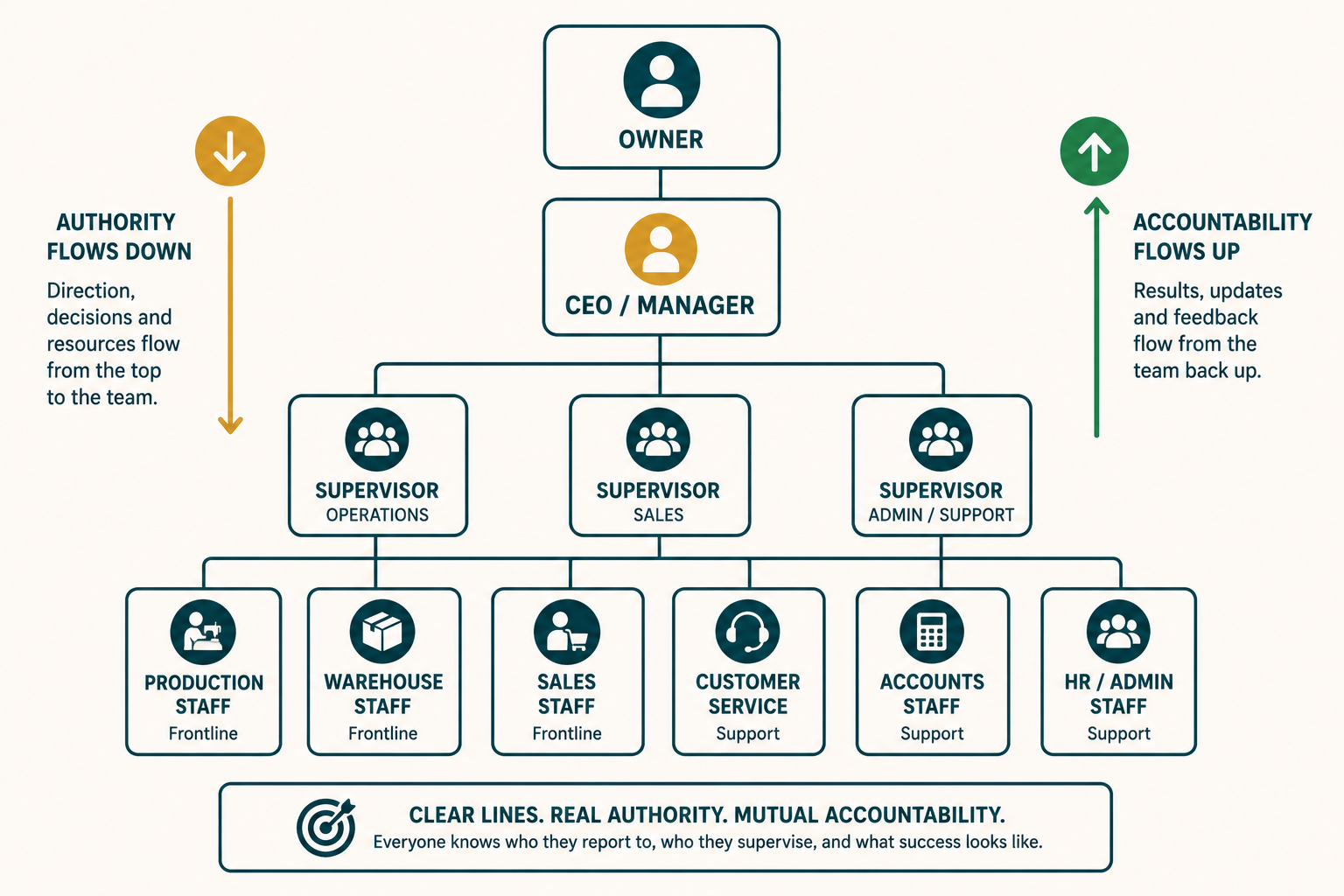
Supervisors exist because owners and CEOs cannot personally watch every workstation, every day. A supervisor's job has four pillars, quality, attendance, training, and workflow, plus a fifth that ties them together: problem-solving, the daily judgment calls too small and too frequent to escalate upward. A supervisor with genuine authority over these five is what lets a business grow past what one person can personally watch.
Checks work against the standard before it reaches the customer.
Vol 14Tracks who's present, manages shift coverage, escalates patterns.
Ensures every team member can actually perform their documented systems.
Vol 02Sequences the day's work so orders move smoothly through production.
Vol 18Makes the dozens of small daily judgment calls too minor to escalate, but too important to leave undecided.
| Pillar | What the Supervisor Actually Does |
|---|---|
| Quality | Checks work against the standard before it reaches the customer (Volume 14: Quality Control) |
| Attendance | Tracks who's present, manages shift coverage, escalates patterns |
| Training | Ensures every team member can actually perform their documented systems |
| Workflow | Sequences the day's work so orders move smoothly through production (Volume 18: Daily Operations) |
| Problem-solving | Makes the dozens of small daily judgment calls too minor to escalate, but too important to leave undecided |
That fifth pillar is where Chapter 1's matrix is tested constantly: a supervisor who must escalate every small decision isn't supervising, they're relaying, and the business has effectively gained a job title without gaining capacity.
A supervisor's job is to make daily decisions on the owner's behalf, without asking first. If every decision still has to reach the owner, the supervisor has a title but not real authority.
| Decision | Should a Supervisor Decide This Alone? |
|---|---|
| Reassign today's tasks between two trained staff | Yes |
| Approve a same-day small expense (e.g., a missing thread colour) | Yes, up to a set limit |
| Send someone home for repeated lateness, per policy | Yes |
| Hire or fire a permanent staff member | Usually escalated (Chapter 8) |
| Change the department's overall pricing or targets | No, this is CEO/owner level (Chapter 3) |
A useful test: if the decision repeats daily and the cost of a wrong call is small, it belongs to the supervisor. If it's rare and expensive, it escalates. Writing this line down explicitly, not leaving it to instinct, is what turns a job title into real capacity, and is exactly the kind of clause Chapter 7's role description exists to capture.
Here's the full version of the supervisor story from the start of this chapter.
MANIAC MINDZ's first Production Supervisor called Mr A for almost every decision: which order to prioritize when two were due the same day, whether a slightly-off stitch was good enough to pass, whether a tailor could leave early for a family emergency. On paper, she held the title. In practice, she was Chapter 1's Danger Zone, expected to run the floor, but with every real lever still in someone else's hand, because nobody had ever written down which calls were hers to make.
The fix was a half-page document: a written quality standard she could apply without asking, a same-day expense limit, and explicit permission to reprioritize orders using a stated rule (earliest deadline first, unless a VIP customer is affected). Within a month, the daily calls to Mr A dropped by more than half, not because she became more decisive, but because she finally knew, in writing, what was already hers to decide.
| Business | Supervisor Role | Their Five Pillars in Practice |
|---|---|---|
| City Kitchen | Shift Supervisor | Checks food quality, manages the roster, trains new servers, sequences orders during rush, decides table reassignments |
| Rapid Auto Works | Workshop Supervisor | Inspects finished repairs, tracks mechanic attendance, trains on new vehicle models, sequences bay assignments, resolves parts-delay conflicts |
| Green Fields Farm | Field Supervisor | Checks crop health, tracks worker attendance, trains on new equipment, sequences the day's tasks by weather, decides irrigation timing within the season's plan |
As in the example story, a supervisor who must escalate everything is a relay, not a decision-maker. Write the boundary down explicitly.
Being the best tailor and being able to manage six tailors are different skills entirely, see Chapter 8's training section.
The opposite failure, a supervisor making owner-level calls (pricing, hiring, major purchases) alone recreates the "Loose Cannon" quadrant from Chapter 1.