Volume 16, Chapter 2
Receipts, Invoices, and Credit Sales
Definition
Picture a trusted, long-standing customer who's always paid eventually. One order goes on credit. Then another. Then another. Each one feels small and safe on its own, so nobody writes down a running total. Months later, someone finally adds up every unpaid invoice, and the number is big enough to strain the business's own cash.
A receipt confirms money has already been paid. An invoice requests payment that hasn't happened yet. A credit sale delivers goods or services now while payment arrives later, creating accounts receivable: money owed to the business, real but not yet cash.
Why does it matter whether this owed money is written down anywhere? Because money that exists only as a memory of "they'll pay me eventually" is invisible on any actual record, and invisible debts are the ones that quietly pile up until they hurt. Volume 07, Chapter 4 already described this as an unpaid invoice sitting in a pipe that hasn't opened yet. This chapter names that pipe properly, accounts receivable, and gives it a process.
A receipt is for money already paid, an invoice is for money not yet paid, and every credit sale needs to be written down somewhere, or it becomes invisible debt that only surfaces when it's already a problem.
Cash Sale vs Credit Sale
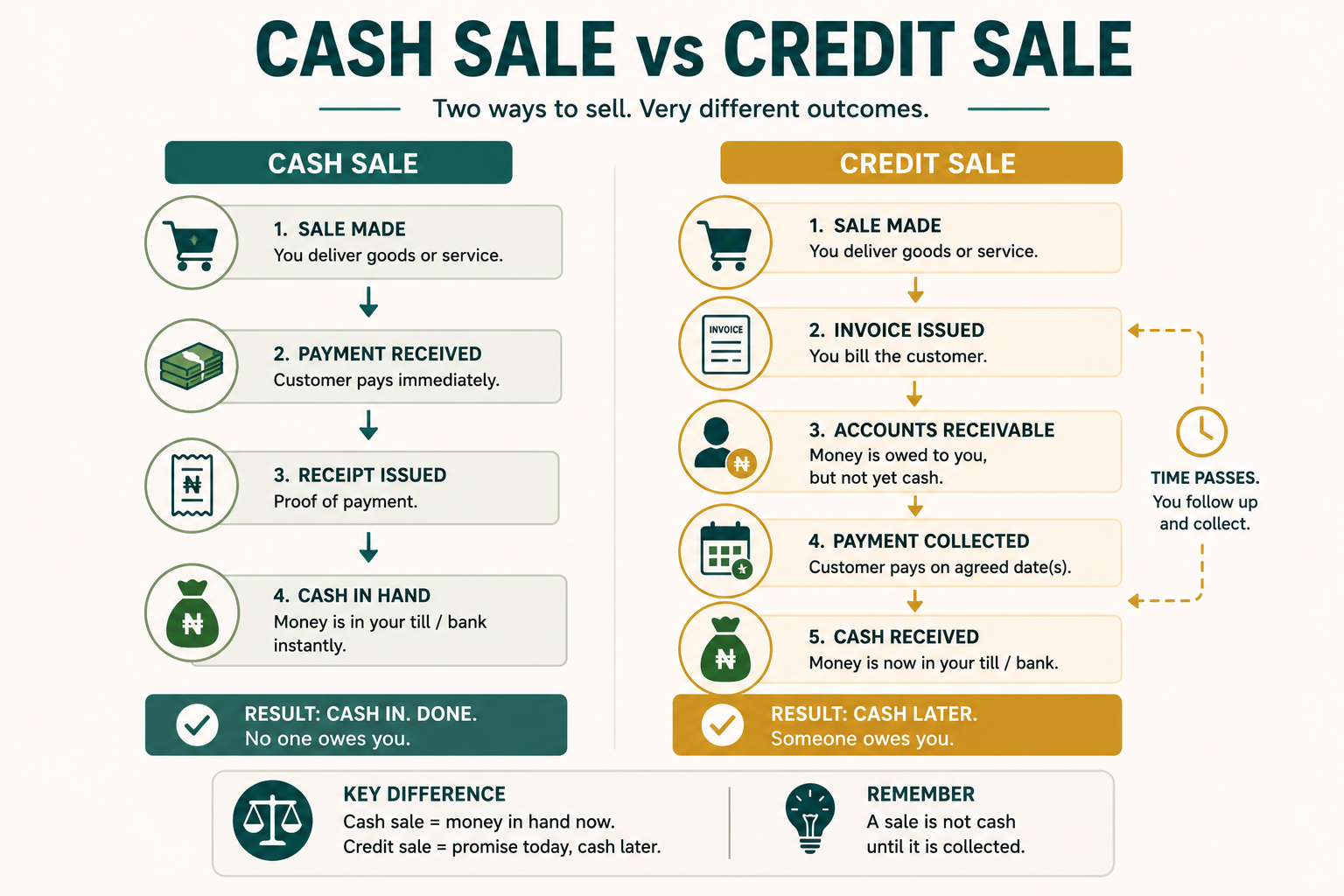
| Cash Sale | Credit Sale | |
|---|---|---|
| Document issued | Receipt | Invoice |
| When is it paid? | Immediately | Later, on agreed terms |
| What sits on the books in between? | Nothing, already cash | Accounts receivable |
| Main risk | None beyond the sale itself | Non-payment |
A credit sale is a small loan to the customer, in everything but name. It deserves the same deliberate approval a loan would get, not an automatic "of course" because the customer is friendly or familiar.
Extending Credit Responsibly
A written credit limit per customer
Prevents an informally growing balance nobody explicitly agreed to.
An approval step above a set amount
The same approval ladder logic already used for expenses and refunds.
A running receivables log
Makes total outstanding credit visible at a glance, not reconstructed from memory.
Agreed payment terms in writing
Removes ambiguity about exactly when payment is due.
Ready-to-use tools: Invoice Form · Receivables Log
Example Story: The Credit That Added Up Quietly
Here's the full version of the growing-credit story from the start of this chapter.
A trusted, long-standing MANIAC MINDZ customer was extended credit informally, order after order, with no running total kept anywhere. Each individual sale felt small and safe on its own. By the time anyone added up the unpaid invoices across several months, the outstanding balance was large enough to strain the business's own cash, exactly the "profit on paper, no cash in the tank" problem Volume 07, Chapter 4 warns about.
No single sale had been the mistake. The missing log was. A simple receivables log, totalled monthly, would have surfaced the growing balance long before it became a real strain.
Across Industries
Credit sales show up wherever a business trusts a regular customer to pay later. Here's what that looks like in three different trades.
| Business | A Credit Sale Situation |
|---|---|
| Golden Crust Bakery | A restaurant client paying monthly for daily standing orders |
| Rapid Auto Works | A fleet customer with multiple vehicles, invoiced together |
| Precision Print & Press | A corporate client with agreed 30-day payment terms |
Common Mistakes
Exactly the example story, individually small credit sales that become a large, unnoticed balance together.
Leaves "when should this be paid?" as an assumption, not an agreement.
Familiarity isn't a credit check, Volume 10's non-payment risk applies to trusted customers too.
Quiz Yourself
Practice Exercise
List every customer currently buying on credit. For each, write down the agreed payment terms and current outstanding balance using the Receivables Log, even if this is the first time it's been tracked in one place.
Quick Summary
Quick Summary
- A receipt confirms payment already made; an invoice requests payment still owed.
- A credit sale creates accounts receivable, real money owed, but not yet cash in hand.
- Extend credit with a written limit, an approval step, and a running log, never on familiarity alone.