Both can be true at once
"We made ₦3,000,000 profit" and "we have ₦600,000 and rent is due Friday" can both be honest.
Volume 07, Chapter 4
Profit is what the business has earned on paper. Cash is what is actually available to spend. A business can be genuinely profitable and still be unable to pay its rent this month.
Three timing gaps separate the two, credit sales, tied-up inventory, and lump-sum payments. A cash flow forecast, tracked separately from the profit statement, is the only fix.
"We made ₦3,000,000 profit" and "we have ₦600,000 and rent is due Friday" can both be honest.
Credit sales, tied-up inventory, and lump-sum bills all create a lag between profit and cash.
Today's balance says nothing about what's due tomorrow.
Paying suppliers in 30 days while collecting in 90 guarantees a permanent cash gap.
Imagine a tailoring shop lands a large uniform contract, invoiced at delivery with 60-day payment terms. It's a genuinely profitable order, fully counted in that month's profit. But payroll and fabric bills are due long before that money arrives, and the ₦4,000,000 owed isn't collectible for two more months. The business is profitable and can still nearly miss payroll, both at once, both true.
is an accounting result, revenue minus costs, on paper, whether or not the cash has actually changed hands. Cash flow is the real, physical movement of money in and out of the bank account, right now. A business can be genuinely profitable and still be unable to pay its rent this month.
This is arguably the single most dangerous gap in small business finance. More profitable businesses fail from running out of cash than from a lack of profit. Profit counts a sale the moment it's made, even if the customer hasn't paid yet. Cash flow only counts money once it's actually landed in the account. The lag between the two is where businesses quietly starve while their own paperwork insists they're doing well.
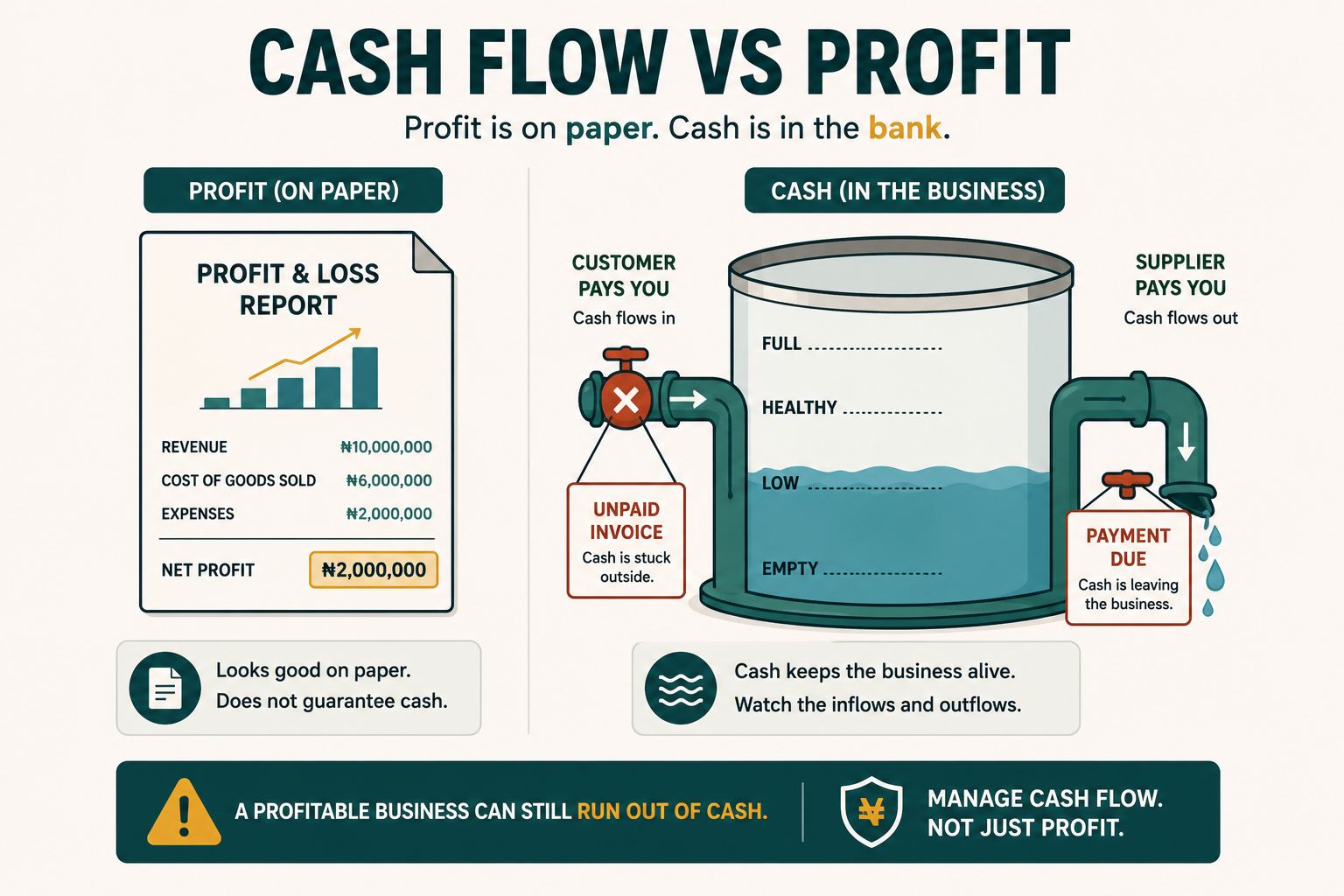
A profit report is a piece of paper. It can say, truthfully, that the business earned ₦3,000,000 last month.
The cash tank is a physical container. What's actually in it right now depends on what has really flowed in and out, including money customers still owe (an unpaid invoice sitting outside the tank, in a pipe that hasn't opened yet) and money the business owes suppliers (about to drain out, whether or not new cash has arrived to replace it).
Both statements can be true at the same time: "We made ₦3,000,000 in profit last month" and "We only have ₦600,000 in the bank and rent is due Friday."
Profit is what the business has earned on paper. Cash is what is actually available to spend. A signed order for ₦2,000,000, unpaid, is real profit on the books and exactly ₦0 in the bank until it's collected.
A sale counts as revenue immediately, but the customer pays in 30/60/90 days.
Profit now, cash laterCash was already spent buying materials that haven't sold yet.
Cash out before profit existsRent, tax, or a big supplier bill lands all at once, unrelated to that month's profit.
Unrelated to that month| Gap | What Happens | Effect on Cash |
|---|---|---|
| Credit sales | A sale is made and counted as revenue, but the customer pays in 30/60/90 days | Profit rises immediately; cash arrives later |
| Inventory tied up | Cash was already spent buying materials that haven't sold yet | Cash left the tank before any profit from selling them exists |
| Large one-time payments | Rent, tax, or a big supplier bill lands all at once | Cash drains in a lump, unrelated to that month's actual profit |
Recall Chapter 1's capital-vs-profit lesson: money that looks like profit on paper is often still capital in disguise, tied up in stock or in a customer's unpaid invoice, not yet safely converted into cash the business can actually spend.
The tool for staying ahead of this gap is a simple, honest forecast, projecting cash in and cash out, week by week or month by month, regardless of what profit says:
| This Month (Forecast) | |
|---|---|
| Cash at start of month | ₦600,000 |
| + Expected cash collected from customers | ₦3,500,000 |
| − Expected payments to suppliers | −₦2,000,000 |
| − Rent, salaries, other fixed costs | −₦1,800,000 |
| = Projected cash at month end | ₦300,000 |
Notice this table never mentions "profit" once, it only tracks cash actually expected to move. Full worked template: Cash Flow Forecast Worksheet, built out further in Chapter 10: Budgeting and Forecasting.
Here's the full version of the uniform-contract story from the start of this chapter.
MANIAC MINDZ took on a large uniform contract, invoiced at delivery with 60-day payment terms, a genuinely profitable order, fully counted in that month's profit. But payroll and fabric supplier bills were due in the meantime, and the ₦4,000,000 owed by the client wasn't collectible for two more months.
Only a cash flow forecast, checked in advance, surfaced the coming shortfall early enough to negotiate a shorter payment window with the client and delay one supplier payment by two weeks. The order was, and remained, genuinely profitable, it was cash timing, not profitability, that nearly caused a crisis.
A healthy profit report says nothing about whether Friday's rent is actually covered. Check the cash forecast separately, every week.
Paying suppliers in 30 days while collecting from customers in 90 guarantees a permanent cash gap, no matter how profitable each sale is.
The bank balance today says nothing about what's due tomorrow. A forecast is what turns a surprise shortfall into a manageable, plannable one.