Not every sale is profit
Selling first returns your own money to you. It does not create new money, it just moves your capital from goods into cash.
Volume 07, Chapter 1
Cash arriving is not the same as wealth arriving. Your business has not actually gained money until its total value is higher than what you started with, after every expense is paid.
Every naira that arrives passes through three stages before any of it is safely yours: recovering capital, breaking even, then real profit. Spend before that third stage and you're spending money the business still needs.
Selling first returns your own money to you. It does not create new money, it just moves your capital from goods into cash.
Recovering exactly what you started with is real, but it isn't gain.
Inventory worth ₦10,000 on paper isn't ₦10,000 in cash today, until it actually sells.
Cash on hand doesn't yet account for the rent, wages, and bills due before month end.
Imagine a fabric retailer has her best-looking month ever, ₦800,000 in sales, cash arriving every single day. She spends part of it renovating her shopfront. It feels earned. Three weeks later, she can't restock. Almost none of that ₦800,000 was ever hers to spend, most of it was capital owed straight back to buying more fabric, and rent and wages still to come. Section 6 tells this story in full.
is the money you put into the business to buy the things it sells. Profit is what's left over, but only after that capital has been fully recovered and every expense has been paid. Selling something is not the same as profiting from it; selling first returns your own money to you.
One of the biggest mistakes small business owners make is thinking that every sale is profit. It isn't. When you sell something, you're first getting your capital back. The money simply moves from goods into cash, it hasn't grown yet. Only once every naira of capital is recovered, and every expense is paid, can whatever's left be called profit. Spend the cash before that point, and you're not spending profit, you're spending money the business still needs to survive.
Days 0-1. Cash arrives, but total value hasn't grown, goods are simply turning into cash.
Days 0-1Cash received now equals what you started with. Back to zero, not ahead.
Day 2Capital is fully recovered and every expense is paid. What's left is genuinely yours.
The finish lineYou have ₦10,000.
You use it to buy goods worth ₦10,000.
You plan to sell all those goods for ₦20,000.
| Amount | |
|---|---|
| Capital | ₦10,000 |
| Expected profit | ₦10,000 |
| Total selling value | ₦20,000 |
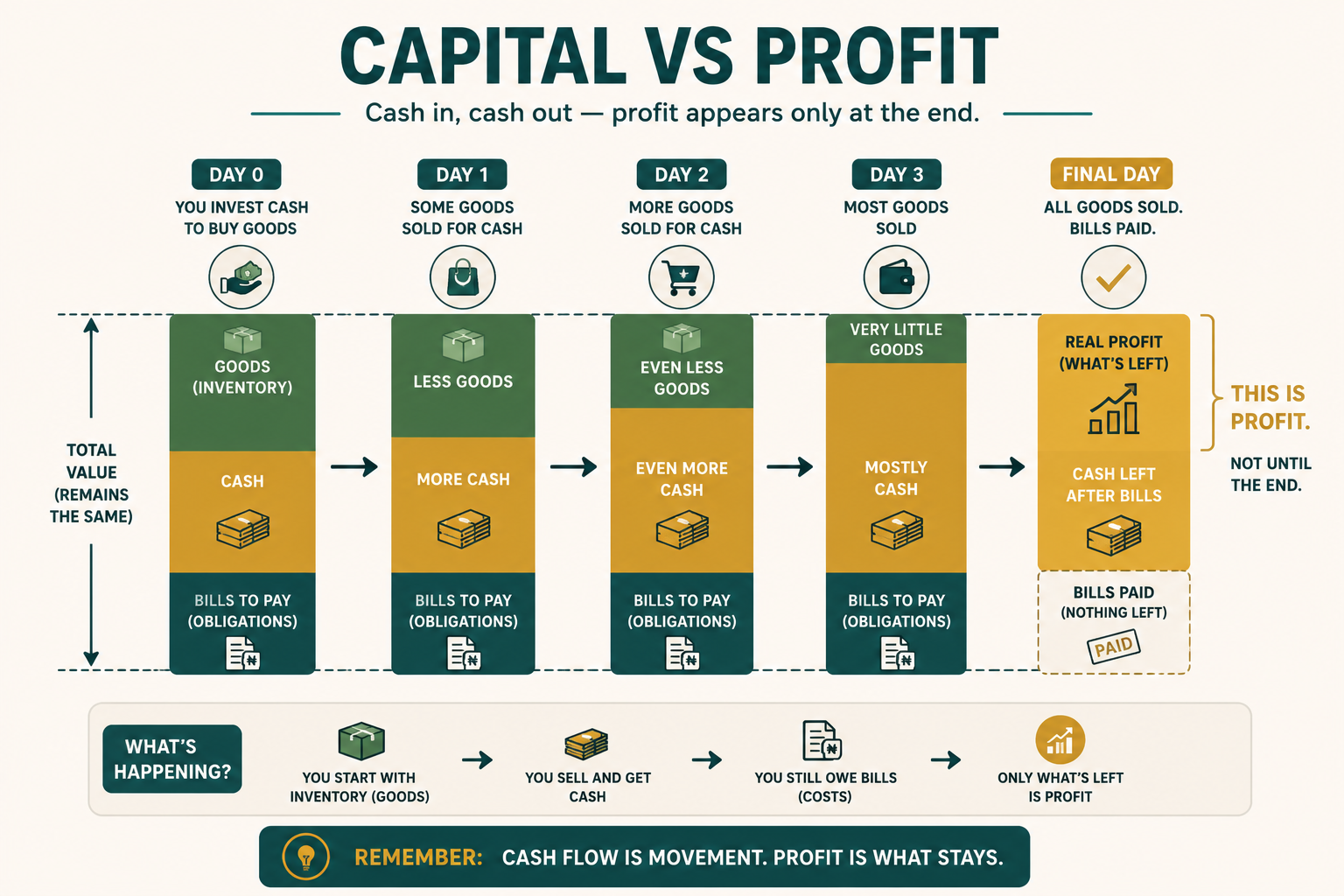
You sell goods worth ₦5,000.
Now you have: Cash ₦5,000 · Goods left to sell ₦15,000.
Have you made a profit? No. Nothing has increased. You've simply turned part of your inventory into cash. You still own the same total value:
₦5,000 cash + ₦15,000 worth of goods = ₦20,000
The total value is the same. It has just moved from goods into cash, it has not grown.
You sell another ₦5,000 worth of goods.
Now you have: Cash ₦10,000 · Goods left ₦10,000.
Have you made a profit now? Still no. You have only recovered the money you originally invested. You're back to where you started, this is called breaking even.
Cash arriving is not the same as wealth arriving. You haven't gained anything until your total value is higher than what you started with, after every expense is paid. Until then, you've only moved money from one form to another.
Many business owners see the cash coming in and think: "Business is doing well."
So they start spending the money. But they forget that the same money is still needed to:
If you spend your capital, you'll eventually have no money left to restock, even if sales seemed good every single day.
This is the single most common reason a busy business quietly runs out of cash. Every naira of capital spent as if it were profit is a naira that must be borrowed, begged, or gone without, later.
Some products sell fast. Others sit for weeks or months. So even if your inventory is worth ₦10,000 on paper, it may not be worth ₦10,000 in real cash today, some of it might sell next week, some of it might sit until it goes out of fashion or expires.
That's why you should never rely on estimates. Count your stock regularly. Know exactly what you have. (Volume 13: Inventory Management covers stock counts and valuation in full; Volume 04, Chapter 6 covers the register that tracks it.)
You have made a profit only when:
That money left over, the green slice in the diagram above, is your profit. Continuing the story: if the remaining ₦10,000 of goods eventually sells in full, and along the way the business pays ₦3,000 in transport, rent, and other running costs, the real result is:
| Amount | |
|---|---|
| Total cash from all sales | ₦20,000 |
| − Capital recovered (yours to restock with) | −₦10,000 |
| − Expenses paid | −₦3,000 |
| = Real profit | ₦7,000 |
Not ₦20,000. Not even ₦10,000. Only ₦7,000. That is the only part of the total that is genuinely, safely yours to spend or save.
Here's the full version of the fabric retailer's story from the start of this chapter.
A small fabric retailer had her best-looking month ever: ₦800,000 in sales, cash arriving daily. She used part of it to renovate her shopfront, it felt earned.
Three weeks later, she couldn't restock. The ₦800,000 had never been profit, most of it was capital owed back to inventory, plus rent and staff wages still to come. The renovation had been paid for with money that belonged to next month's stock. The shop survived, but only after a lean quarter spent quietly rebuilding the capital that had been spent as if it were profit.
The mistake this entire chapter exists to correct. Test every naira that arrives against the question: "Has my total capital-plus-expenses been recovered yet?"
"About ₦10,000 of stock left" becomes a real number only when someone actually counts it. See Volume 13.
Cash on hand today doesn't yet account for the rent, wages, and bills due before the month ends. Profit is only what's left after those are paid, not before.