Volume 20, Chapter 5
Physical Security: CCTV and Beyond
Definition
A customer reported a disputed transaction several days after it happened. MANIAC MINDZ went looking for the CCTV footage to resolve it, only to find the retention period was far shorter than the delay in reporting. The footage had already been overwritten.
protects the premises, equipment, and stock through layered technology and hardware, CCTV, alarms, and access control, working together rather than any single measure alone. This is Volume 18, Chapter 3's layered security fully built out, with the CCTV chapter it promised.
Why does a camera that was recording the whole time still fail to help? Because a camera only protects the business if its footage still exists by the time someone actually needs it, and if someone is actually looking. A camera that isn't pointed at the right place, or footage nobody reviews before it's overwritten, provides false comfort rather than real security.
This chapter covers where to place technology-based security layers and how to make sure they're actually usable when something happens, not just present.
Security Layers, Visualized
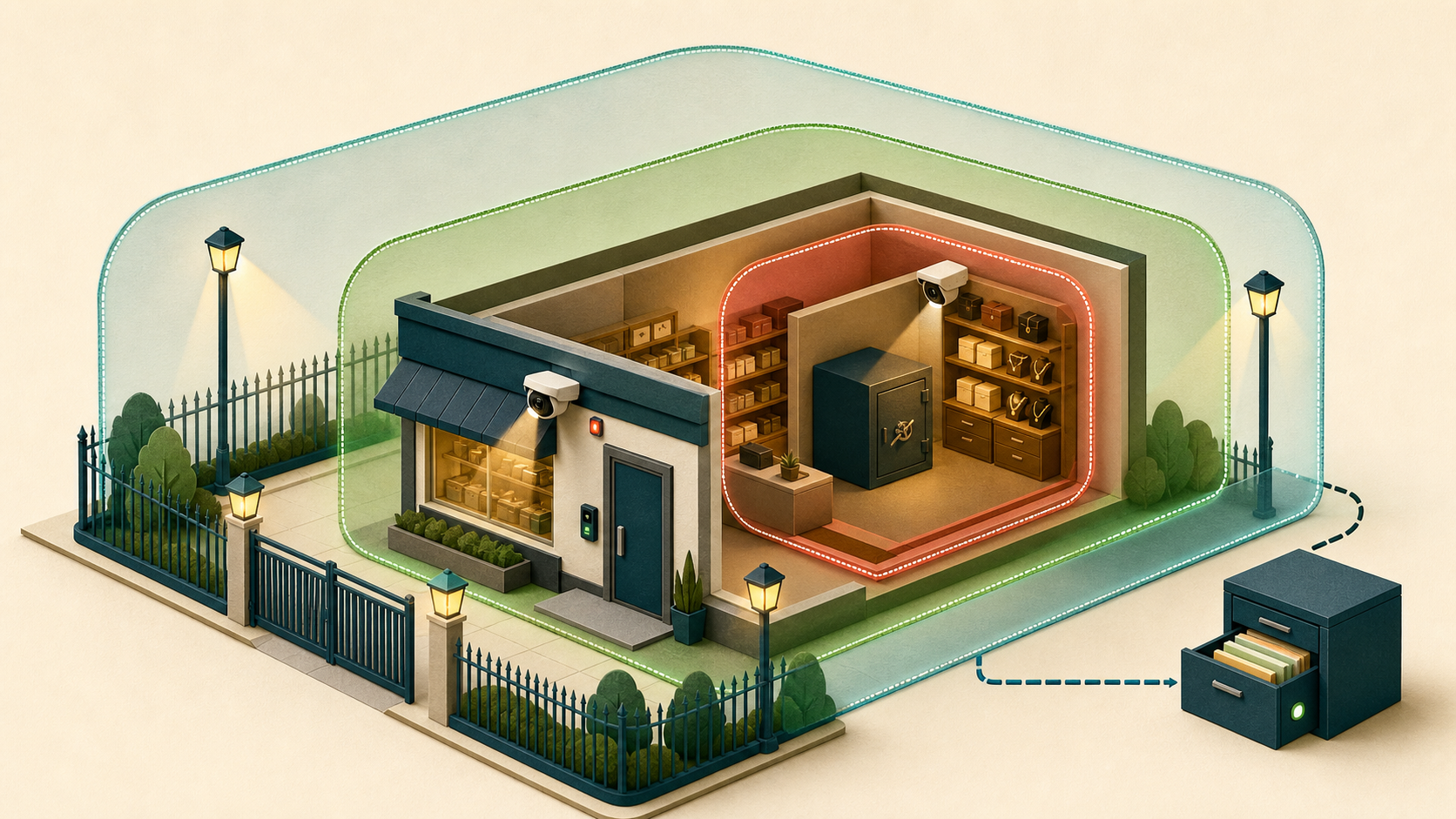
| Layer | Technology | Priority Placement |
|---|---|---|
| Perimeter | Fencing, lighting, outer locks | Any point someone could enter unnoticed |
| Building access | Entry doors, alarm system, general CCTV | Every entry point, not just the front door |
| Restricted zone | Focused CCTV, a secured safe | Cash handling area (Volume 11's cash controls), high-value stock |
A camera is only as useful as the footage someone actually reviews, and only as long as it's actually retained. Installing it is the easy part; using it is what matters.
Making CCTV Actually Useful
Cover entry points and the cash handling area first
The highest-value, highest-risk locations.
Set a retention period long enough to matter
The retention period is how long footage is kept before it's overwritten; an incident reported days later needs footage that still exists.
Assign someone to actually review footage periodically
Deters exactly the kind of small, repeated loss Volume 11's fraud triangle describes.
Example Story: The Footage That Was Already Gone
Here's the full version of the overwritten-footage story from the start of this chapter.
A problem reported by a customer several days after a disputed transaction sent MANIAC MINDZ looking for CCTV footage of the incident. The system's retention period was far shorter than the delay in reporting, and the footage had already been overwritten.
The camera had done its job perfectly. The retention setting hadn't. Extending the retention period, and clarifying who was responsible for periodically checking the system was actually working, meant the next similar dispute had real footage available to resolve it.
Across Industries
Where security matters most shifts depending on what each business is actually protecting.
| Business | A Physical Security Priority |
|---|---|
| Golden Crust Bakery | Camera coverage of the till area during busy service hours |
| Rapid Auto Works | Secured, monitored storage for customer vehicles overnight |
| Precision Print & Press | Access control on the room holding client artwork and finished print runs |
Common Mistakes
This is the exact failure in the example story: footage gone before anyone needed it.
Provides a false sense of security without any real deterrent or investigative value.
Recall Volume 18, Chapter 3: one layer can fail silently; several layers together rarely fail the same way at once.
Quiz Yourself
Practice Exercise
Using the Physical Security Audit Checklist, review your current camera placement, retention period, and who is responsible for reviewing footage.
Quick Summary
Quick Summary
- Physical security works in layers: perimeter, building access, and a restricted zone for the highest-value areas.
- CCTV is only useful with an adequate retention period and someone actually reviewing footage.
- Next, Chapter 6: Internet, Email, and Office Equipment covers the everyday office systems that quietly keep the business running.