Volume 17, Chapter 3
Campaign Planning and Budgeting
Definition
An early paid promotion at MANIAC MINDZ kept receiving "just a bit more" budget whenever it seemed to be working. There was no ceiling set in advance, and no specific number anyone had agreed would prove it was actually working. By the time someone finally added up the total spend, it was far more than any planned budget line would have allowed.
A campaign is a planned, time-limited marketing effort with a specific goal, a defined budget, and a way to measure whether it worked, never just "posting more" with no ceiling and no way to know afterward if it succeeded.
Why does an informal "let's just try it and see" approach so easily turn into overspending? Because without a ceiling agreed in advance, every single extra dollar looks reasonable in the moment, it's only the running total, added up afterward, that reveals the problem. A campaign's whole job is deciding the ceiling and the success measure before any money moves, while judgement is still calm.
A campaign is Volume 08's goal-setting discipline and Volume 07's budgeting discipline applied to marketing: a fixed amount of money, spent over a fixed period, aimed at a specific, checkable outcome, not open-ended spending in the hope that something works.
The Funnel a Campaign Feeds
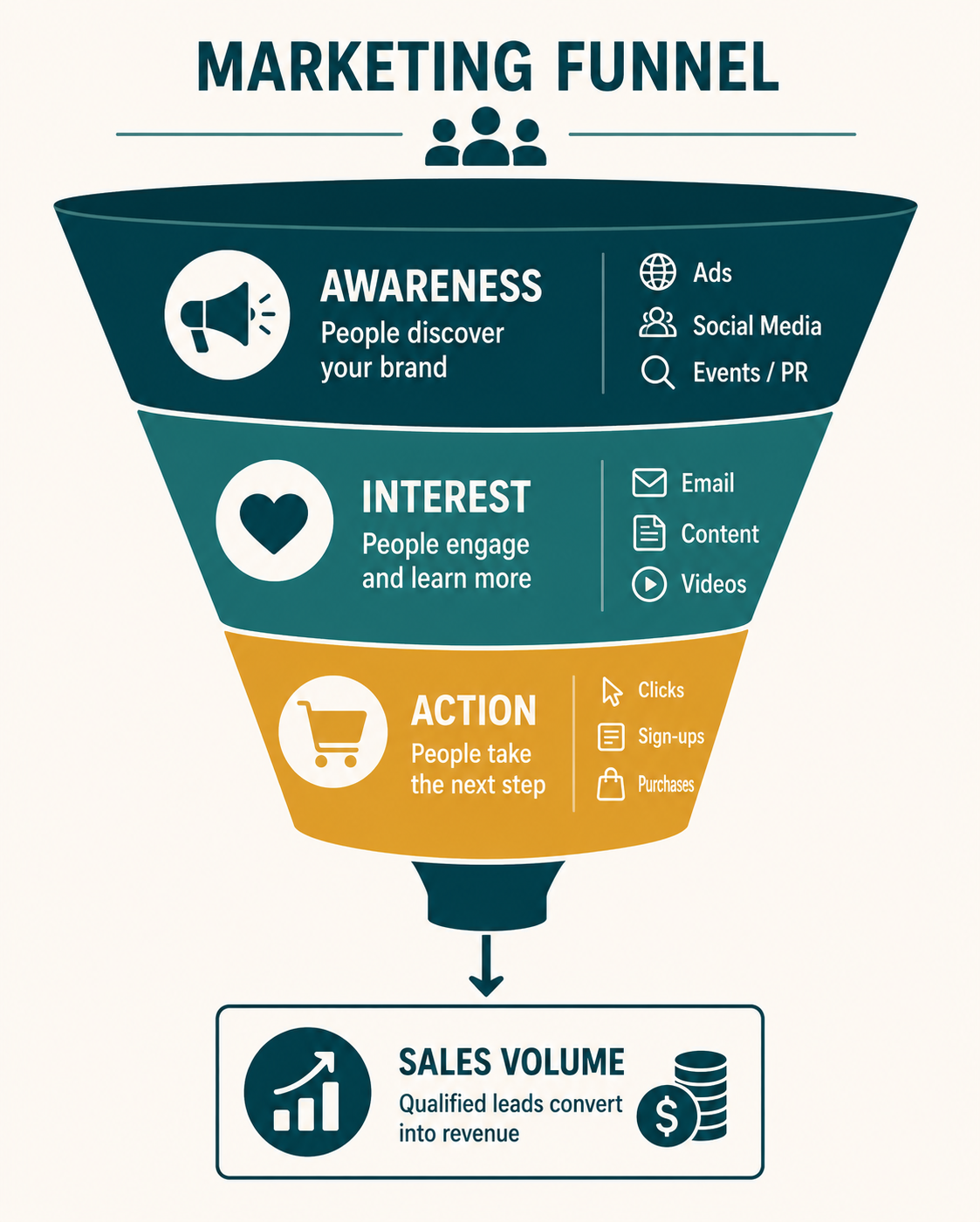
Every campaign should be clear about which stage of the funnel (the path from first awareness down to buying) it's targeting, awareness (Chapter 1), interest (Chapter 2's consistent content), or action, which hands off directly into Volume 16's sales process.
Planning a Campaign
| Element | Question It Answers |
|---|---|
| Goal | What specific, dated outcome are we aiming for? (per Volume 08's goal discipline) |
| Target segment | Which customer segment is this aimed at? |
| Budget | What is the fixed ceiling, treated exactly like any other budget line? |
| Channel | Which platform(s) from Chapter 1, matched to the target segment? |
| Timeframe | Start and end date, a campaign that never ends isn't a campaign, it's just spending |
| Success metric | What specific, checkable number decides if it worked? |
A campaign has a start date, an end date, a ceiling, and a number that tells you if it worked. Anything missing one of those four things is a hope, not a campaign.
Example Story: The Ad Spend With No Ceiling
Here's the full version of the no-ceiling ad spend story from the start of this chapter.
An early paid promotion at MANIAC MINDZ kept receiving "just a bit more" budget whenever it seemed to be working, with no predefined ceiling and no specific metric to confirm it actually was. By the time anyone added up the total spend, it far exceeded what any planned budget line would have allowed, and nobody could say with confidence how many real orders it had actually produced.
The spending had felt reasonable at every single step. Only the total was the problem. The next campaign fixed both gaps at once: a firm budget ceiling set in advance, and one specific number (new registered customers, per Volume 15, Chapter 1) agreed as the success measure before a single naira was spent.
Across Industries
A campaign's goal, budget, and timeframe change completely depending on what's being sold and to whom.
| Business | A Campaign Example |
|---|---|
| Golden Crust Bakery | A two-week holiday-season promotion with a fixed ad budget and a target for higher sales |
| Rapid Auto Works | A "free inspection" campaign aimed at customers who've stopped coming, measured by re-bookings |
| Precision Print & Press | A back-to-school print promotion with a defined start/end date and a new-order target |
Common Mistakes
Produces exactly the open-ended spend in the example story.
Makes it impossible to know, afterward, whether the campaign was actually worth repeating.
Without a timeframe, "campaign" quietly becomes indistinguishable from ordinary, un-budgeted spending.
Quiz Yourself
Practice Exercise
Plan your next marketing campaign using the Campaign Planning Worksheet: a specific goal, target segment, fixed budget, channel, timeframe, and success metric, all agreed before any spending begins.
Quick Summary
Quick Summary
- A campaign is planned, budgeted, and time-limited, not open-ended spending in the hope something works.
- Every campaign should target a specific funnel stage: awareness, interest, or action.
- Set the budget ceiling and success metric before spending begins, not after.
- Volume 17 complete. Next, Volume 18: Daily Operations covers the rhythm that keeps the business running every single day.