A goal needs a date
"Someday we'll expand" can never be checked, missed, or celebrated.
Volume 08, Chapter 1
Long-term goals set the final target. Medium-term goals are the checkpoints on the way there. Short-term goals are the specific steps you take this year.
Every shorter goal should be a stepping stone toward a longer one, never floating free of it.
"Someday we'll expand" can never be checked, missed, or celebrated.
A goal is a number or a checkable fact, never a feeling.
Disconnected goals can feel like progress, but they are just a distraction.
A goal set once and never checked is the "budget with no actuals" mistake.
Imagine an owner has said "we should grow" every year for years, with nothing ever actually changing. Then one year, "grow" becomes something else: "hire 2 trained tailors by June, open a second workshop by next March, reach 3 cities within 5 years." Nothing about the ambition changed. What changed is that it finally became something that could be checked, missed, or hit.
A goal is a specific, dated target that turns a vision into something checkable. Short-term goals (within a year), medium-term goals (1–3 years), and long-term goals (3–10 years) exist at different distances from today, but every shorter goal should be a stepping stone toward a longer one, never floating free of it.
Volume 01's vision said where the business is going. This chapter says when it should arrive, in stages. A vision with no goals is a wish; a goal disconnected from the vision is just busywork.
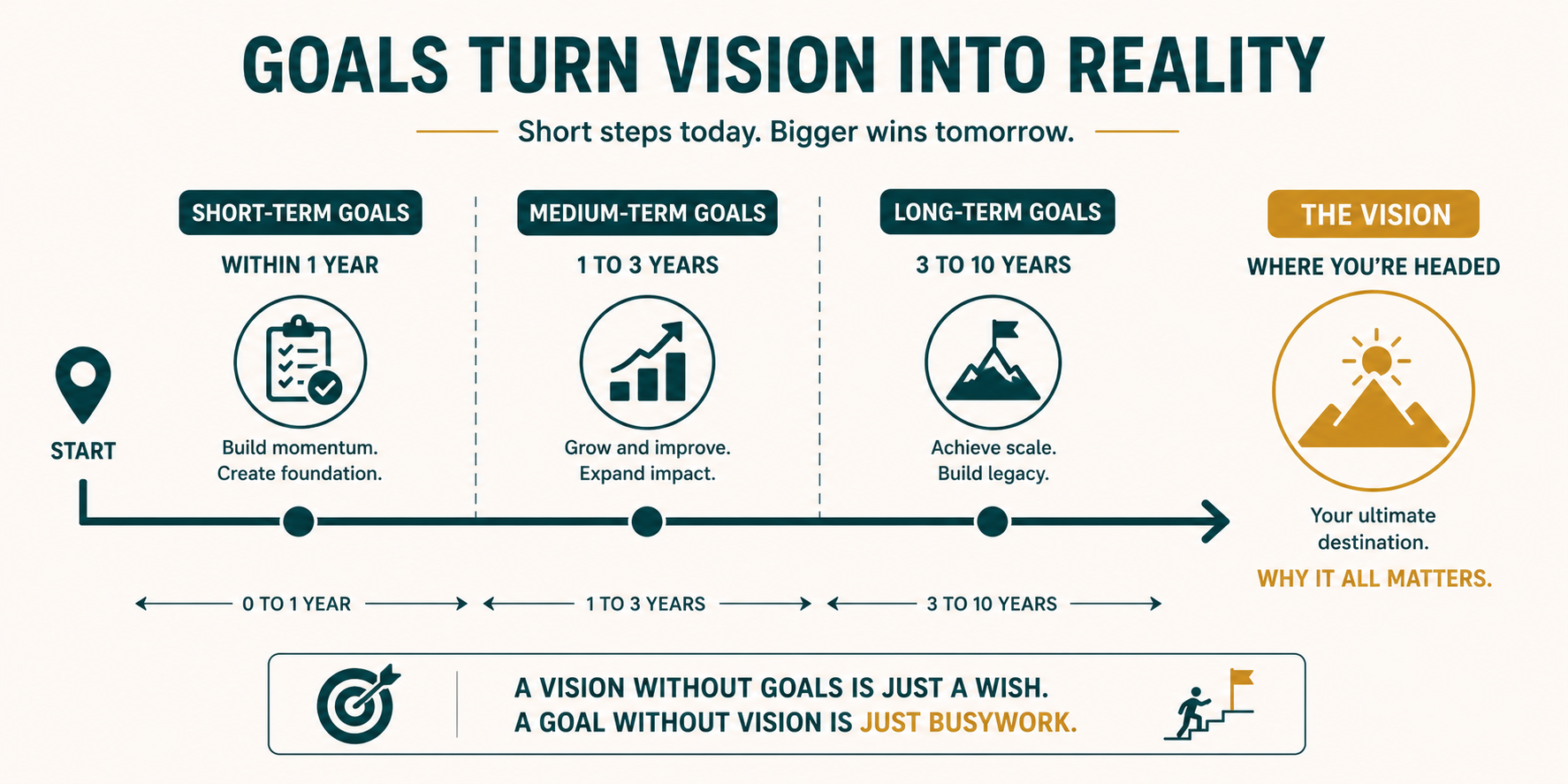
Within 1 year. Example: hire and fully train 2 new tailors.
1–3 years. Example: open a second workshop location.
3–10 years. Example: operate in 3 cities; explore franchising.
Vol 26| Horizon | Time Frame | MANIAC MINDZ Example |
|---|---|---|
| Short-term | Within 1 year | Hire and fully train 2 new tailors |
| Medium-term | 1–3 years | Open a second workshop location |
| Long-term | 3–10 years | Operate in 3 cities; explore franchising (Volume 26: Scaling) |
Notice the chain: hiring trained tailors (short-term) is what makes a second workshop (medium-term) staffable; a proven second workshop is what makes expanding to 3 cities (long-term) credible. Goals that don't connect to each other, and to the vision, are just a to-do list. They are not a strategy.
Long-term goals set the final target. Medium-term goals are the checkpoints on the way there. Short-term goals are the specific steps you take this year. Losing sight of the long-term goal turns planned progress into aimless activity.
| Vague Goal | Specific, Checkable Goal |
|---|---|
| "Grow the business" | "Increase monthly garment output from 80 to 120 by December" |
| "Improve quality" | "Reduce rework rate from 8% to under 3% within 6 months" |
| "Expand" | "Open a second workshop in [specific area] by the third quarter of next year" |
This is exactly Volume 06, Chapter 7's KPI discipline applied to the whole business instead of one role, a goal must be a number or a checkable fact, never a feeling.
Here's the full version of the goal-setting story from the start of this chapter.
MANIAC MINDZ's owner had said "we should grow" for years, with nothing to show for it. The year that changed was the year "grow" became: "Hire 2 trained tailors by June, open a second workshop by next March, reach 3 cities within 5 years." Each goal had a date, a number, and a visible link to the one after it. Progress could be checked monthly against Volume 21's KPI habits, and for the first time, "growth" stopped being a feeling and started being a plan with a scoreboard.
| Business | Short-Term | Medium-Term | Long-Term |
|---|---|---|---|
| Golden Crust Bakery | Add 2 new bread lines this year | Open a delivery service within 2 years | Supply 3 major retailers within 5 years |
| Nimbus Labs | Reach 500 paying users this year | Launch a second product line in 2 years | Expand to 3 countries in 7 years |
"Someday we'll expand" can never be checked, missed, or celebrated, see Section 3.
A short-term goal unrelated to the medium-term one can feel like progress, but it is just a distraction.
Goals set once and never checked against actual progress are exactly the "budget with no actuals" mistake from Volume 07, Chapter 10, applied to strategy instead of money.
Using the Goal-Setting Worksheet, write one short-term, one medium-term, and one long-term goal for your business, each specific, dated, and visibly connected to the one after it.