Volume 15, Chapter 3
Loyalty, VIP Customers, and Discount Policy
Definition
Imagine a staff member quietly gives a regular customer a "just this once" discount, meaning only to be kind. The same customer gets it again on the next order. And the one after that. By the fourth order, the customer expects it as standard. Charging full price on the fifth order now feels, to them, like a price increase, even though nothing about the actual price ever changed except who was keeping track.
is a written rule that decides which customers get extra recognition; a VIP customer is one who meets it. A discount policy is the written rule for when a price may be reduced at all. Both replace "because I like this customer" with a criterion anyone applying it would reach the same way.
Why does an unwritten discount cause more harm than either offering it formally or never offering it at all? Because a kindness nobody wrote down doesn't stay a kindness. It quietly becomes the price the customer expects, and taking it away later feels like punishment, even though it was never actually promised.
Loyalty status and discounts feel generous, but without a written rule they quietly become unfair, the same customer treated differently depending on who's serving them, or a discount habit that erodes the pricing policy until nobody remembers why the price was set where it was.
The Loyalty Pyramid
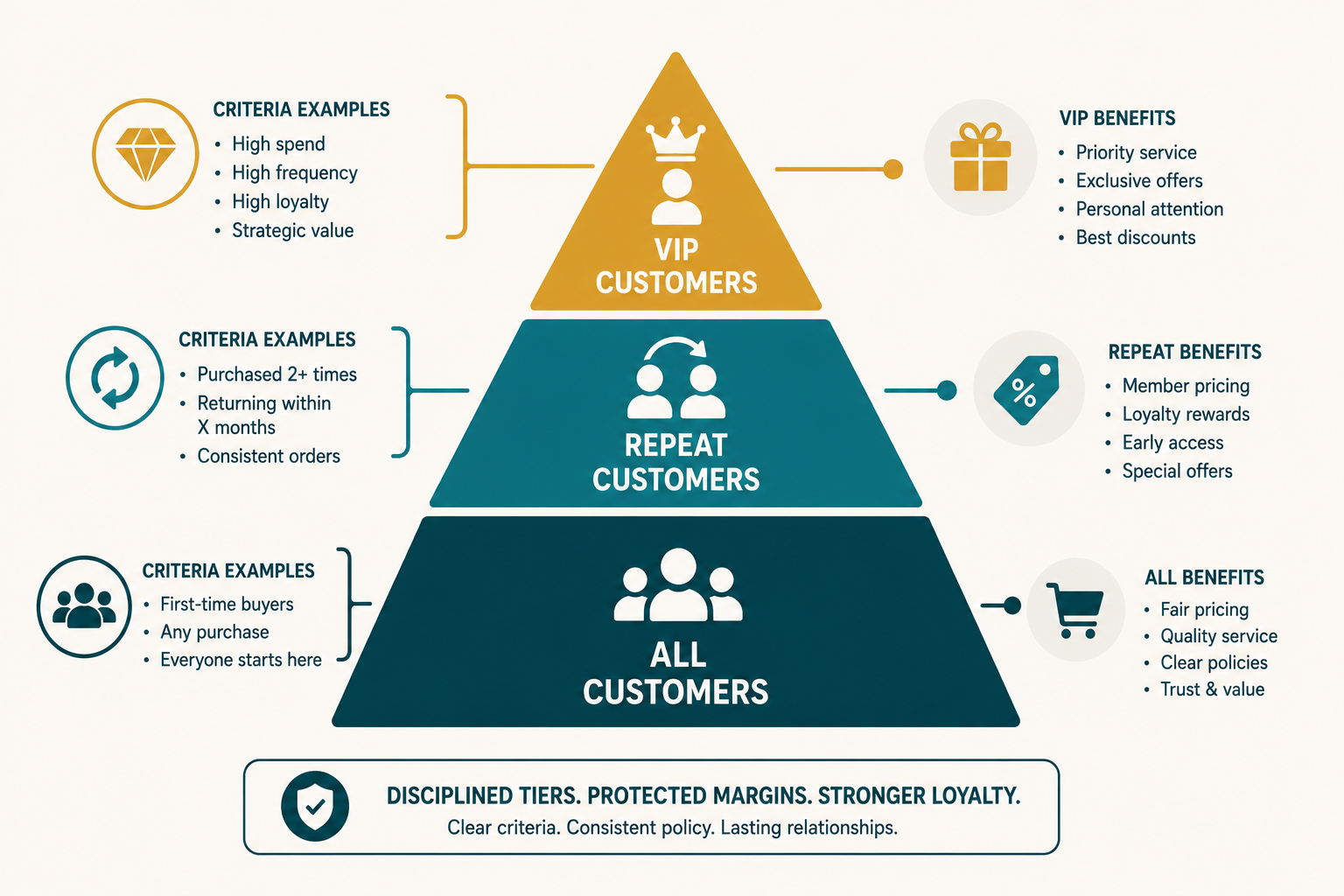
| Tier | Written Criterion (Example) | What They Get |
|---|---|---|
| All Customers | Registered (Chapter 1) | Standard service |
| Repeat Customers | 2+ purchases on file | Priority scheduling, a small standing courtesy |
| VIP | A specific, written threshold (e.g., spend, order count, or referral count over a set period) | Defined extra benefits, agreed in advance |
Movement up the pyramid follows a written rule, never a feeling. The moment "VIP" means "whoever the owner likes best," the whole tier stops meaning anything to staff trying to apply it consistently.
Discount Policy and the Pricing Floor
Recall Volume 07, Chapter 6's break-even floor: every price sits above a specific point below which the business loses money. A discount policy exists to make sure discounts never quietly cross that floor:
| Discount Type | Should Be |
|---|---|
| Standard/seasonal discount | A fixed, pre-approved percentage, available to anyone who qualifies |
| Loyalty/VIP discount | Tied to the written tier criteria from Section 2 |
| One-off goodwill discount | Subject to the same approval ladder as a refund, a documented limit per role |
An undocumented discount, given often enough, quietly becomes the customer's expected price, and taking it back later damages the relationship far more than never offering it would have.
Example Story: The Discount That Became the Price
Here's the full version of the drifting-discount story from the start of this chapter.
A regular MANIAC MINDZ customer received an undocumented "just this once" discount, then received it again, and again, with no written record of why. By the fourth order it was simply expected. The fifth order, charged at full price, felt like an unexplained increase.
The following month, an actual loyalty and discount policy was written down, with clear, disclosed criteria. The invisible, drifting exception became a real benefit the customer could see and qualify for, on the same terms as anyone else.
Across Industries
A good loyalty rule is simple enough to state in one sentence and the same for every customer who qualifies.
| Business | A Loyalty/Discount Approach |
|---|---|
| Golden Crust Bakery | Every 10th standing order, one loaf free, a fixed, disclosed rule |
| Rapid Auto Works | Free basic inspection for customers with 3+ prior repairs on file |
| Precision Print & Press | Volume discount tiers published upfront, not negotiated case by case |
Common Mistakes
Different staff apply it inconsistently, and it can look like favouritism from the outside.
Becomes the expected price, as the example story shows, and erodes the pricing policy without anyone deciding it should.
The same on-the-spot risk Chapter 2 already covers for refunds, applied here to discounts instead.
Quiz Yourself
Practice Exercise
Write your loyalty tier criteria and discount policy down, even if simple. Use the Loyalty Tier Criteria Worksheet to define exactly what qualifies a customer for each tier.
Quick Summary
Quick Summary
- Loyalty tiers and VIP status need a written criterion, never a feeling, to stay fair and consistent.
- Discounts should never quietly erode the pricing policy's break-even floor.
- Goodwill discounts follow the same written approval ladder as refunds.