Volume 05, Chapter 3
Sizes, Grading, and Measurement Intelligence
Can One Pattern Make Every Size?
Definition
Imagine a business owner asks: can't we just make one pattern and stretch it to fit every size? Try it and a small shirt looks fine, but by the time it's stretched to fit a much larger body, the collar looks tiny, the sleeves look short, and nothing sits right anymore. Simply scaling a shape bigger does not keep it looking like the same garment. Something more deliberate is needed.
is the process of scaling a single master pattern up or down to produce a full range of sizes, while keeping every part of the garment in the same proportion to every other part, instead of simply making the whole thing bigger or smaller by the same amount everywhere.
"Can one mould make every size?" It depends on the method used. There are three real approaches: one pattern per customer (perfect fit, no scalability), one pattern per size (standard, but doesn't fit unusual bodies), and a master pattern plus grading, the industry-standard middle path used by every serious garment manufacturer. And no customer perfectly matches a standard size: real systems record the closest base size plus the individual alterations layered on top, so the next order starts from a known baseline instead of zero.
Three Approaches to Sizing
| Method | How It Works | Fit Quality | Scalability |
|---|---|---|---|
| 1. One pattern per customer | A unique pattern cut for each individual | Perfect | Terrible, one customer, one pattern, no reuse |
| 2. One pattern per size | Fixed patterns for S, M, L, XL, XXL | Good for people who match the size exactly | Excellent, simple to produce at volume |
| 3. Master pattern + grading | One master pattern; grading rules enlarge or reduce it proportionally | Very good, adjustable | Excellent, the industry standard |
Luxury bespoke (fully custom-made) tailoring leans toward Method 1. Most clothing brands use Method 2. Professional garment manufacturers use Method 3, because it keeps quality and cost predictable at any volume without losing proportional accuracy.
How Grading Actually Works
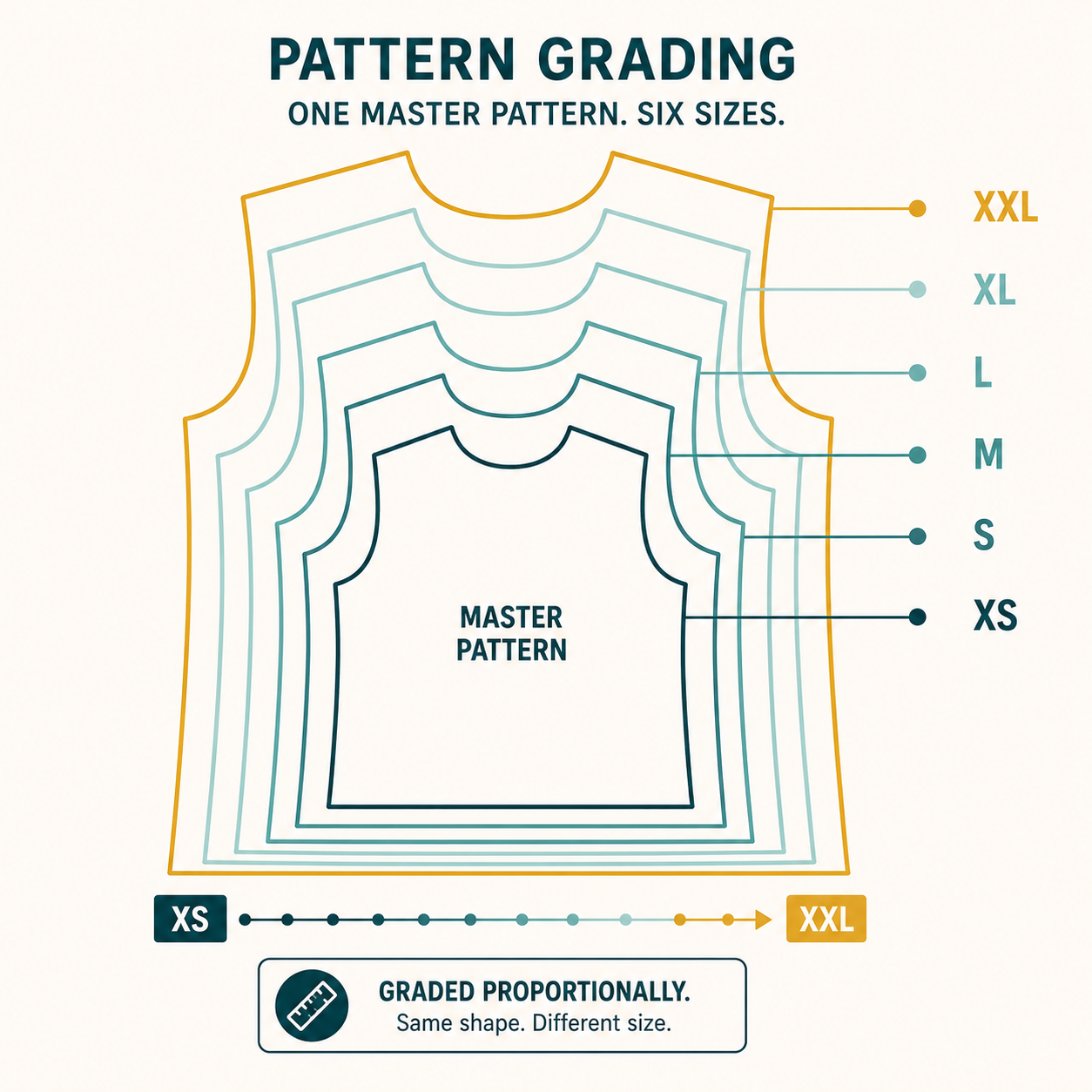
Software (or a manual grading rule) enlarges or reduces the master pattern by a fixed, proportional increment at each size step, this is called pattern grading, and it's the industry standard because it keeps every measurement growing in proportion to every other measurement, rather than simply adding the same number of centimetres everywhere (which would make a garment fit worse, not better, the further a size sits from the master).
Grading changes every measurement by its own proportional amount. It does not just add the same number everywhere. That is what keeps a large size looking like the same garment as the small size, instead of a distorted version of it.
What If the Customer's Body Doesn't Match a Standard Size?
This is extremely common, someone might have medium shoulders, a large waist, small hips, long arms, and a short torso, all at once. In that case, you don't pick a different pattern, you pick the closest base size, then adjust the specific areas that differ.
A good system records:
| Field | Example |
|---|---|
| Base pattern used | Men's Shirt M, v3.2 |
| Individual alterations | +3 cm sleeve, −2 cm waist, +1.5 cm chest |
| Final measurements | The actual numbers the garment was cut to |
| Fitting notes | Anything observed during the fitting |
That way, if the customer returns, the next garment starts from a known baseline, closest base size plus a known alteration list, instead of remeasuring and reasoning from zero every time.
Should a Bigger Size Cost More?
This is a genuine business-policy question, not a fabric question alone, and different businesses answer it differently:
| Option | How It Works | Best For |
|---|---|---|
| One price for all sizes | Simple to advertise; the business absorbs the extra material cost for larger sizes | Retail clothing brands prioritizing simplicity |
| Size-based pricing | Larger garments cost more, reflecting real fabric, interfacing, thread, and labour differences | Businesses where cost differences are significant and customers expect transparency |
| Material-based pricing | The base tailoring fee stays constant; only significant extra fabric or special materials are charged separately | Bespoke tailoring, where the final price already depends heavily on customer choices |
Size-based pricing, done carelessly, can feel like a punishment to customers regardless of how fair the underlying cost math is. If you choose it, explain the reason (fabric quantity, not body size) clearly in your price list, this is as much a brand decision as a costing one.
The Measurement Intelligence System
A basic system stores raw measurements and stops there. A genuinely useful one stores enough to answer questions two years later without a single guess:
| Field | Captures |
|---|---|
| Body measurements | The customer's actual body, as measured |
| Finished garment measurements | What the garment itself measured, once complete |
| Ease allowance | How much extra room was intentionally added beyond the body measurement |
| Pattern version used | Which exact version of the base pattern (ties into Chapter 5's version control) |
| Alteration history | Every adjustment made, and when |
| Before/after fitting photos | Visual proof of fit, not just numbers |
| Weight/body-change notes | Optional, customer-provided, tracked over time |
| Preferred fit | "Slim," "regular," "relaxed", a stated preference, not an assumption |
| Measurement dates | When each measurement was taken |
With this, the system can answer questions like: "Has this customer's chest measurement changed?" "Which jacket pattern gave the best fit last time?" "Did they prefer the slimmer sleeve or the wider one?"
At this point, the business is no longer just storing orders, it's building institutional knowledge that improves quality, consistency, and customer experience over time, entirely independent of which staff member happens to be on duty. This is exactly the Customer Module idea from Volume 20, Chapter 1, applied specifically to fit.
Example Story: The Sleeve That Was Already Known
A returning MANIAC MINDZ customer arrived for a second jacket, bracing to explain his awkward proportions again. Instead, the measurement record showed: base pattern Men's Jacket L v2.1, +2 cm sleeve, −1 cm waist, "prefers slightly wider shoulder, noted from first fitting." The second fitting needed one adjustment instead of six. What felt like the tailor "just remembering him" was actually a filing habit from Chapter 7 of Volume 04, the same discipline, applied to fit.
Common Mistakes
Adding 4 cm to every measurement at every size step distorts proportions the further a size sits from the master, grading must scale each measurement by its own proportional increment.
The fix isn't a new pattern from scratch, it's the closest base size, plus a recorded set of alterations (Section 4).
Without the base pattern, version, and alteration list, a "successful fit" can't be reproduced next time, only re-discovered, the slow way.
If pricing by size is inconsistent from customer to customer, it looks arbitrary even when the underlying costs are fair. Pick one policy from Section 5 and apply it consistently.
Quiz Yourself
Practice Exercise
- Pick one of your existing base patterns. Write its grading increments for at least three sizes (what changes, by how much, at each step).
- Pick a real customer who doesn't match a standard size. Record their closest base size plus their specific alteration list, using Section 4's fields.
- Decide, in writing, which of the three sizing pricing policies your business actually follows, and check whether your current price list matches it.
- For one repeat customer, fill in the full Measurement Intelligence table from Section 6.
Quick Summary
Quick Summary
- Three sizing approaches: one pattern per customer (perfect fit, no scale), one pattern per size (scalable, imperfect for unusual bodies), master pattern + grading (the industry standard, proportional, scalable, adjustable).
- Grading scales every measurement in proportion, it never just adds the same amount everywhere.
- An unusual body doesn't need a new pattern, it needs the closest base size plus recorded alterations.
- Sizing pricing is a policy decision: one price for all, size-based, or material-based, pick one and apply it consistently.
- A full Measurement Intelligence record (body + garment measurements, ease, version, alterations, photos, preferences, dates) turns fit into institutional knowledge, not personal memory.