Protects both sides
The founder from sudden withdrawal, the investor from their own capital being torn out mid-build.
Volume 03, Chapter 10
Locked money builds; nervous money wrecks. An investor unwilling to lock is telling you their money is nervous.
A lock-in makes the capital stay long enough to do its job; an exit window makes the eventual departure orderly instead of catastrophic.
The founder from sudden withdrawal, the investor from their own capital being torn out mid-build.
More than invested if the business grew, less if it shrank, that's equity, both directions.
Past distributions were rent the money earned, not repayments of the slice.
An exiting investor isn't an emergency; a business emptied of cash is.
Imagine receiving ₦5,000,000 today, and six months later the investor calls and says, "I want my money back now." That sentence could destroy the business: the money is no longer sitting in a bank account. It has already become half-installed machines, fabric on order, and a deposit on a second workshop. There is nothing left to simply hand back.
A lock-in period is a contractual promise that the investor will not withdraw their investment, sell their shares, or demand redemption for a specified number of years. An exit window is the pre-agreed, orderly process that begins when the lock expires and the investor wants out.
Imagine receiving ₦5,000,000 today, and six months later the investor says, "I want my money back." That sentence could destroy the business: the money is now machines, fabric, and a second workshop. A lock-in makes the capital stay long enough to do its job; an exit window makes the eventual departure orderly instead of catastrophic, priced by an agreed method, offered to the founder first, and paid over a window the business can survive. This is one of the most overlooked clauses in small-business investing, and one of the most protective.
Investment capital is like cement being poured into a foundation.
For a while it is wet: the ₦5,000,000 has become half-installed machines, fabric on order, a deposit on the second workshop. Pull it out now and you don't get money back, you get rubble, and the building collapses with it.
Give it time to set, and the same cement holds up a structure worth far more than what was poured in.
A lock-in is simply both sides agreeing, in writing, how long the cement needs. It protects the founder from a sudden demand, and it protects the investor too, because the worst thing for their ₦5,000,000 is a panicked, half-built business trying to refund it.
Locked money builds; nervous money wrecks. An investor unwilling to lock is telling you their money is nervous (Chapter 9, Q5).
There is no universal rule, the period should match how long the money realistically needs to start producing value:
Short-cycle expansion: stock, marketing push, small equipment.
Golden Crust's ovenA growing business's step-up: new premises, several machines, new staff.
Mr B's actual lockHeavy, slow-maturing assets: property, major plant, farm infrastructure.
Green Fields' irrigation| Lock length | Fits when the money funds... | Example |
|---|---|---|
| about 2 years | Short-cycle expansion: stock, marketing push, small equipment | Golden Crust's second oven pays back in 18 months |
| 3–5 years | A growing business's step-up: new premises, several machines, new staff | MANIAC MINDZ's actual 5-year lock on Mr B's investment |
| 5–7 years | Heavy, slow-maturing assets: property, major plant, farm infrastructure | Green Fields' irrigation system |
The test: by the end of the lock, the investment should have had a fair chance to prove itself, so the exit conversation happens about results, not about impatience.
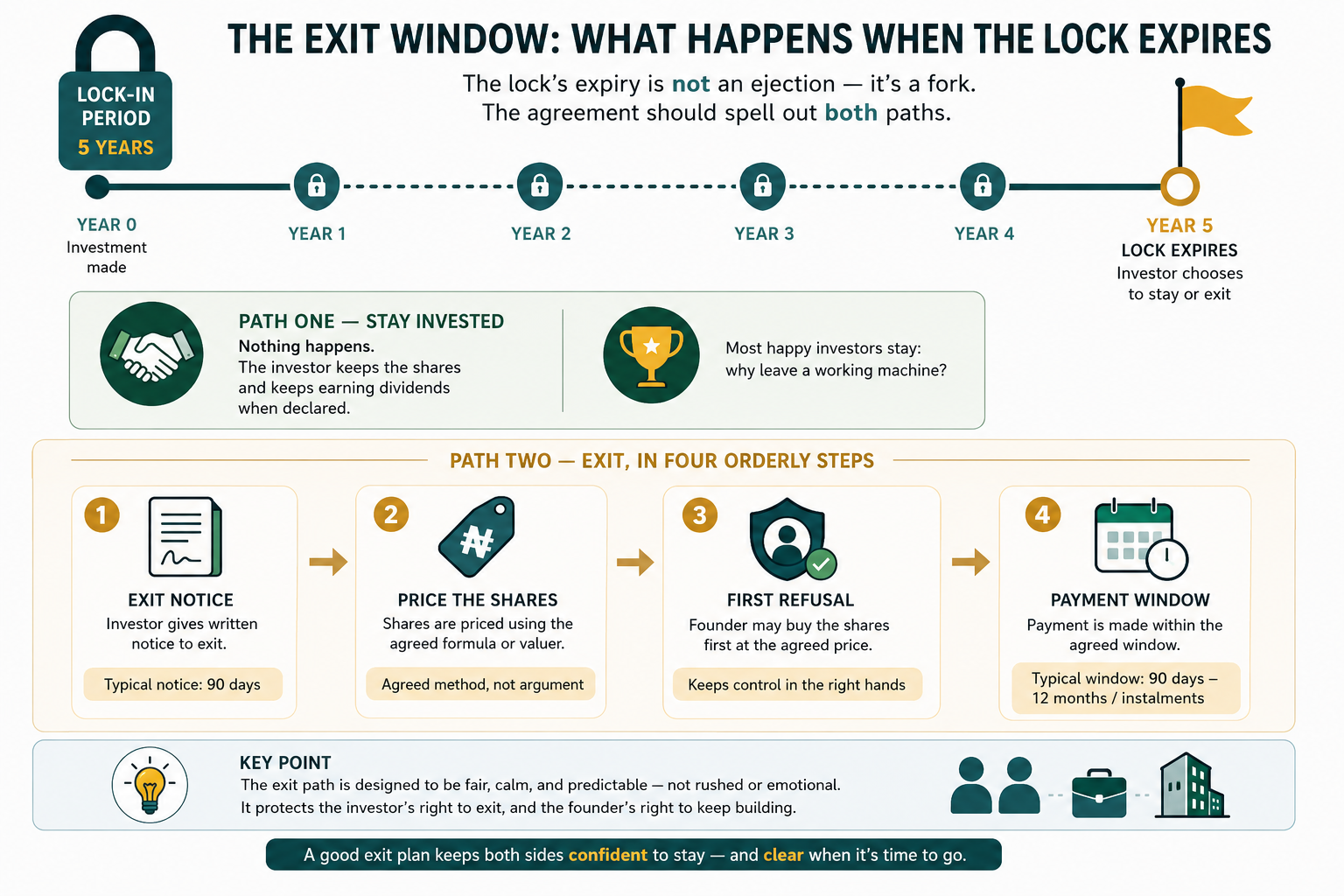
| Step | What the Agreement Should Say |
|---|---|
| 1. Written notice | Exit begins with a letter, not an argument, e.g., "90 days' written notice of intention to exit." |
| 2. Price the shares | How is decided in advance: an agreed formula, or an independent third-party valuation if the parties can't agree (Chapter 11 explains the methods). |
| 3. Founder's right of first refusal | The shares must be offered to the founder (or company) first, at that price, before any outsider, keeping control of who becomes a co-owner. |
| 4. Payment window | The business pays over a survivable window: 90 days, 180 days, 12 months, or instalments, never "immediately." |
Step 4 is where founders sink themselves through guilt. An exiting investor is not an emergency; a business emptied of cash is. The payment window exists so honoring the exit never becomes Chapter 6, insist on instalments long enough that the worst month can carry them (the same test as any debt).
Not necessarily what they put in. It depends entirely on the structure:
| Structure | The Exit Payment Is... |
|---|---|
| Loan | Principal + agreed interest, the arithmetic was fixed on day one (Chapter 5) |
| Equity | The current value of the shares, more than invested if the business grew, less if it shrank |
| Redeemable equity | Whatever the buy-back formula says: fair value, or an agreed multiple (Chapter 14) |
Worked example, Mr B exits at year 6. Business valued at ₦35,000,000 (the figure from the case study); Mr B holds 20%.
| Amount | |
|---|---|
| Mr B invested (year 0) | ₦5,000,000 |
| His 20% is now worth | ₦7,000,000 ← what the exit must pay |
| Paid as | e.g., 12 monthly instalments of ₦583,333 |
And the dividends he received along the way? They don't reduce the ₦7,000,000. Dividends were distributions of past profit, rent the money earned while invested, not repayments of the slice, unless the agreement explicitly says otherwise.
If the business had shrunk to ₦15,000,000 instead, his 20% exit would be worth ₦3,000,000, a loss. That's equity, both directions (Chapter 6).
"He can take his money whenever he wants" turns your equipment fund into money he can pull out at any moment. The cement never gets to set.
The opposite failure: year 6 arrives, the investor wants out, and nothing says how price is set, who buys, or how fast. Now you negotiate the hardest questions at the worst time. Lock and window, always both.
The founder thinks the business is worth ₦20M; the exiting investor insists ₦40M. Without a pre-agreed method or independent-valuer clause, this single blank line becomes the lawsuit. (Chapter 11 gives the methods to name.)
An exit paid all at once can cause the very business failure described in Chapter 6. Windows and instalments are not stinginess, they're the reason the promise is keepable.
Does the investor keep earning dividends during the lock? During the exit window, after notice? Two sentences in the agreement; two annual arguments if omitted.
Draft the lock-and-window clause for your own (real or planned) investment, in plain words: