A loop, not a room
If the shop burned down but you kept your records, patterns, and team, you could rebuild.
Volume 01, Chapter 1
Two tailors run nearly identical shops on the same street. One can disappear for two weeks and the shop keeps taking orders without him. The other's shop simply closes the moment he isn't there. Same skill, same street. So what's actually different between them?
A weak loop stops when one important part disappears. A strong loop keeps running because the work has been written down, shared, and can be done by someone else.
If the shop burned down but you kept your records, patterns, and team, you could rebuild.
A business with high sales but negative profit loses money faster the more it sells.
If every decision lives in the owner's head, the owner isn't running a machine, the owner is the machine.
Only the inputs, process, and output change, the loop itself never does.
Picture two tailors working on the same street in Lagos. Both are equally skilled with a needle. But one of them can travel to his home village for two weeks, and his shop keeps taking orders and making money the whole time he's away. The other tailor's shop simply closes the moment he isn't standing in it.
Same skill. Same street. So what's actually different between them? We'll come back to their full story later in this chapter. For now, here's the short version: the difference isn't talent, it's whether the work runs on a system, or lives entirely inside one person's head.
A business, in the way this manual uses the word, is a system that takes in money, materials, and people, runs them through a process, and produces something a customer will pay for, at a price higher than it cost to make.
Here's a test of that idea. Imagine a fire destroys the workshop tonight. The building is gone. But you still have your customers. Your staff. Your measurement records. Your sewing patterns. Your supplier list.
Could you rebuild? Yes. That's the proof: the business was never the building. It's the loop.
A business is a repeating loop: money, materials, and people go in, work happens, a product comes out, a customer pays, and part of that payment (the profit) goes back in to make the loop stronger next time.
Many people think a business is simply "a place that sells products or services." It isn't, and that's exactly the mistake sitting underneath the difference between our two tailors. One of them, without ever using this word for it, had built a machine. The other hadn't, he was just doing the work himself, day after day.
A business is a machine. Fabric goes in. A tailor measures, cuts, and sews. A customer walks out wearing new clothes. They pay. Part of that money buys more fabric. The cycle begins again.
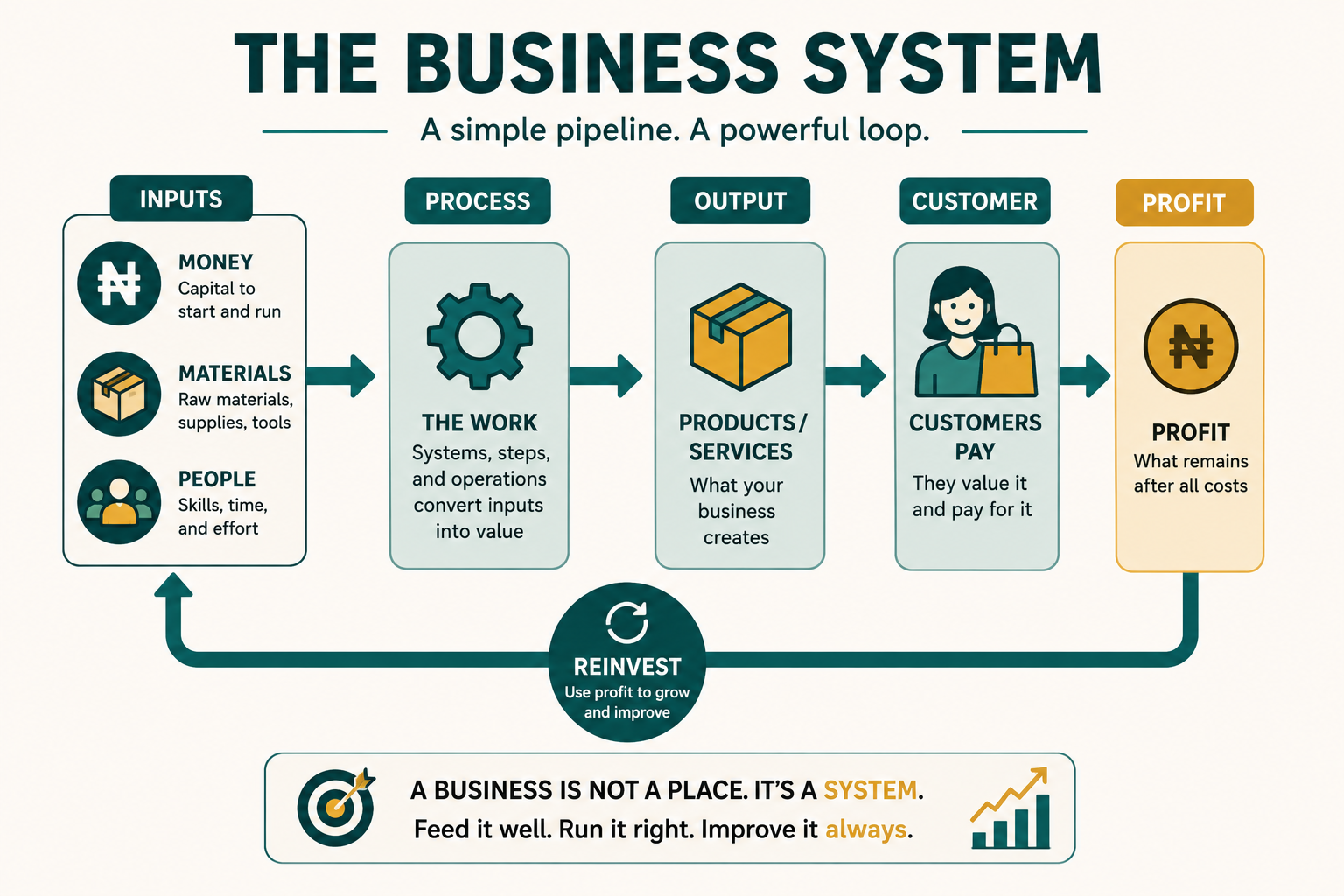
Imagine removing one gear from a machine. The whole machine stops. Businesses work the same way. If one missing employee can stop everything, the business isn't very strong yet.
A strong machine keeps running because every part is understood, written down, and can be done by someone else.
A business is not the room you work in, it is a repeating cycle: money and materials go in, work happens, products come out, customers pay. If that cycle stops the moment you personally stop working, you do not yet own a business. You own a job.
Money, materials, and the skills and hours of everyone involved.
Money · materials · peopleThe steps that turn inputs into outputs, measure, cut, sew, finish.
The workWhat the customer receives, and what they exchange for it.
The saleWhat's left after every input is paid for, fed back to strengthen the loop.
The return| Stage | What It Means | MANIAC MINDZ Example |
|---|---|---|
| Inputs: Money | Cash used to buy what the business needs | ₦50,000 to buy fabric and thread this week |
| Inputs: Materials | The physical things that become the product | Fabric, thread, buttons, zips, lining |
| Inputs: People | The skills and hours of everyone involved | A cutter, two tailors, a finisher |
| Process | The steps that turn inputs into outputs | Measure → cut → sew → fit → finish → press |
| Outputs | What the customer actually receives | A finished agbada or office suit |
| Payment | Customers exchange money for the output | Customer pays ₦20,000 for the suit |
| Profit | What's left after paying for all the inputs | ₦20,000 price − ₦14,000 total costs = ₦6,000 |
| Reinvestment | Profit fed back in to strengthen the loop | ₦6,000 goes toward a better sewing machine |
Profit, the word everyone uses and few define, simply means: the money left over after the business pays for everything it used to make the sale. (Full treatment with all its complications comes in Volume 07: Finance.)
Here's the full version of the story from the start of this chapter.
Two tailors work on the same street in Lagos.
Tailor One is brilliant with his hands. Every measurement lives in his head. He buys fabric when he remembers, charges whatever feels right that day, and when he travels to his village for two weeks, his shop simply closes. Customers wait, or leave.
Tailor Two (Mr A of MANIAC MINDZ) sews no better than Tailor One. But his shop has a measurement book, a price list, a fabric reorder rule ("when the shelf drops below five rolls, buy more"), and an assistant who knows the process. When Mr A travels for two weeks, orders continue. Money continues. The machine keeps turning.
Same street. Same skill. Only one of them owns a system, and only one of them owns something that could ever be grown, handed over, or sold.
This is why an investor will often choose a less profitable business with strong systems over a more profitable one that depends entirely on its owner. The first can survive change. The second can stop working the moment the owner is unavailable, even briefly, for illness or anything else. This idea reappears in Volume 02: Systems Thinking and drives the whole manual.
| Business | Inputs | Process | Output | Customer Pays For |
|---|---|---|---|---|
| MANIAC MINDZ (Tailoring) | Fabric, thread, tailor's hours | Measure, cut, sew, finish | Fitted garment | Clothes that fit perfectly |
| Golden Crust Bakery | Flour, yeast, oven heat, baker's hours | Mix, knead, prove, bake | Bread and pastries | Fresh food, daily |
| Rapid Auto Works | Spare parts, tools, mechanic's hours | Diagnose, repair, test | A working car | Their car back, working |
| Nimbus Labs (Software) | Developer hours, computers | Design, code, test, release | An app or service | A problem solved digitally |
| Green Fields Farm | Seeds, land, water, labour | Plant, tend, harvest | Crops | Food ingredients |
| Bright Path Academy | Teachers, classrooms, materials | Teach, assess, mentor | Educated students | Their children's future |
Every business looks different. A bakery mixes flour. A mechanic repairs cars. A software company writes code. But underneath, they're all doing the same thing: something goes in, work happens, something valuable comes out.
Once you can see the loop in any business, you can ask the only questions that matter: Which part of my loop is weakest? Which part depends on memory instead of a system?
"My business is my shop." We already tested this earlier in the chapter with the fire scenario: the business is the loop, not the room. (This is also why Volume 04: Records matters so much: records are the loop written down.)
Selling ₦1,000,000 of clothes means nothing if they cost ₦1,100,000 to make and sell. High sales with negative profit means the business loses money faster the more it sells. See Volume 07: Finance.
If every decision, every price, and every skill lives in the owner's head, the owner isn't running a machine, the owner is the machine. The whole point of Volume 02: Systems Thinking is escaping this trap.
Draw your own business (or one you know) as the loop from this chapter:
If you disappeared for one month starting tomorrow, no phone, no messages, what exactly would stop? Whatever stops is the part of the loop that is currently you. Is that because only you can do it, or because only you know how?