Volume 14, Chapter 3
Defects, Rejections, and Rework
Definition
Imagine three flawed garments turn up in the same week. One has a lining that will tear apart the first time it's worn. One has a collar that sits slightly crooked. One is missing a single button. Should all three be thrown away? Should all three be quietly fixed and sent out anyway? Treating every defect exactly the same way is either wasteful, throwing away something easily fixed, or risky, sending out something that should never have left the workshop.
is any output that fails Chapter 1's quality standard. Once found, it has exactly three possible fates: rework (fixed and re-inspected), reject (scrapped, becoming waste), or accept with a documented concession, a rare, deliberate exception written down and explained.
Why sort defects into categories at all, instead of just fixing everything or rejecting everything? Because a torn lining and a missing button are not the same problem. Sorting a defect by how serious it actually is tells the business, in a moment, which of the three fates it actually deserves.
A classification step, critical, major, or minor, decides whether something gets fixed, scrapped, or accepted with a note explaining why. Skip that step, and every defect gets treated identically, which is either wasteful or risky.
The Decision Flow
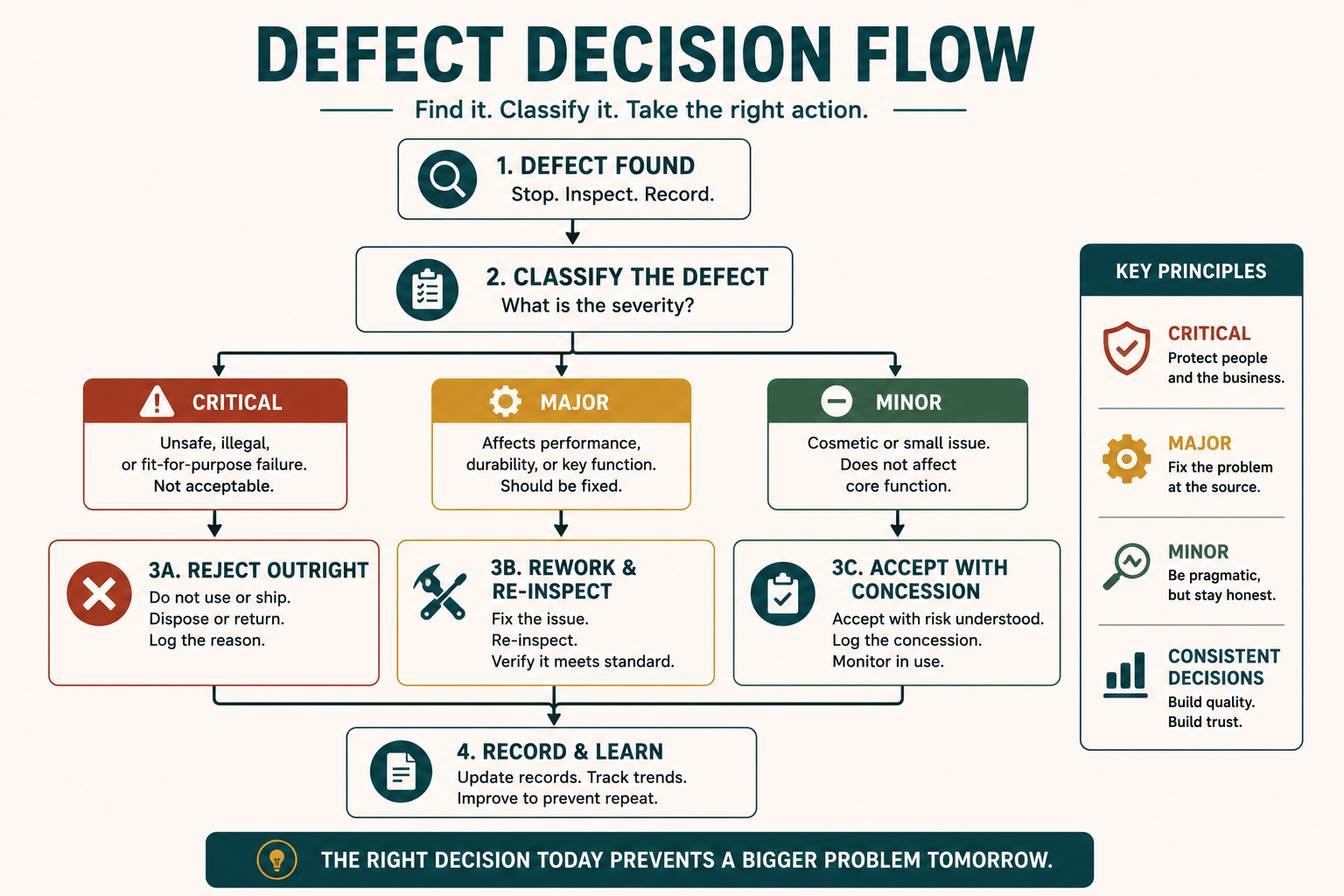
| Severity | Meaning | Typical Response |
|---|---|---|
| Critical | Unsafe or completely unusable | Always rejected |
| Major | Fails a functional or appearance requirement | Reworked if practical and worth the cost; otherwise rejected |
| Minor | Small blemish, doesn't affect function | May be accepted with a documented concession or discount |
Rework fixes it. Reject scraps it. Concession explains, in writing, why it was accepted anyway. Every defect gets exactly one of these three fates, never a silent fourth option of just letting it through unlogged.
Rework Isn't Free, and Isn't the End of the Story
Two disciplines matter once something enters rework:
| Discipline | Why It Matters |
|---|---|
| Re-inspect after rework | A "fixed" item still has to pass the same standard as a first-time item, rework isn't automatically trusted |
| Log the labour and material cost | Rework has a real cost; treating it as free hides the true cost of the defect that caused it |
Closing the Loop: The Defect Log
Every defect, reworked, rejected, or accepted, gets written down in a Defect Log. Divide the number of defects by the number of units produced, and you get a defect rate, a single number that says whether quality is getting better or worse over time, the same way Volume 13's waste rate tracks material loss.
Without a log, "quality feels like it's slipping" is just a feeling. With a rising defect rate on paper, it becomes a specific, checkable signal that something has actually changed, and worth investigating before it gets worse.
Example Story: The Defect the Log Explained
Here's the full version of the three-garments idea, as it actually played out.
A minor defect, a slightly uneven hem, kept appearing across orders that seemed to have nothing in common. Nobody noticed a pattern until the defect log laid several weeks of entries side by side. Every single one traced back to the same machine, which had quietly drifted out of its correct settings.
No one was retrained. No one was blamed. The machine was reset to its correct settings, and the defect disappeared completely.
Across Industries
A defect log only works if the categories match what the business actually makes. Here's what "critical, major, minor" looks like in three different trades.
| Business | A Defect Example | Likely Response |
|---|---|---|
| Golden Crust Bakery | Loaf slightly under target weight | Minor, accept with an internal note, monitor the trend |
| Rapid Auto Works | A repair that fails the post-repair road test | Major, rework and re-test before release |
| Precision Print & Press | A print run with an unsafe chemical exposure risk | Critical, reject and investigate immediately |
Common Mistakes
A "fixed" item that skips re-inspection is an unverified guess, not a confirmed pass.
Loses the exact pattern-detection ability the example story depended on.
Scrapping something easily fixable wastes money; accepting something that should be rejected risks the Chapter 4 complaint that follows.
Quiz Yourself
Practice Exercise
Start a defect log for one week, even informally. Classify every defect found as critical, major, or minor, and record what happened to it. At the end of the week, calculate your defect rate.
Quick Summary
Quick Summary
- Every defect gets classified, critical, major, or minor, and resolved as a rework, a rejection, or a documented concession, never silently ignored.
- Reworked items must be re-inspected against the same standard as any first-time item.
- The defect log turns individual problems into a trackable rate and reveals root causes, rejected items are exactly the "waste" Volume 13 described.