Complementary, not either/or
Insurance covers the catastrophic; the emergency fund covers the routine.
Volume 09, Chapter 5
Some risks are simply too large to absorb alone, no matter how well-prepared the business is. That's what insurance is for: transferring the risk.
Most well-protected businesses use both insurance and an emergency fund, different tools for different sizes of risk.
Insurance covers the catastrophic; the emergency fund covers the routine.
Insure at current replacement value, not original purchase price.
A policy sized for one workshop doesn't cover a second location.
Covers lost income while rebuilding, a gap reserves alone rarely close.
Imagine an electrical fire damages a workshop badly enough that it's unusable for weeks while repairs happen. A well-sized emergency fund can absorb the cost of the damaged machines. But it also has to somehow cover every week of lost income while the doors stay closed, on top of the repair bill, at the same time. That combination is large enough to threaten the business's survival outright. Some losses are simply too big for any reserve fund to carry alone, no matter how well-prepared the business was.
is a contract that transfers a specific risk from the business to an insurer, in exchange for a regular payment (a premium), so that if the covered event happens, the insurer absorbs most of the financial damage instead of the business alone.
Some risks can be prevented (Volume 10) and some can be reserved against (Volume 07's emergency fund), but some are simply too large to absorb alone, no matter how well-prepared the business is. That's what insurance is for: transferring the risk instead of carrying all of it yourself.
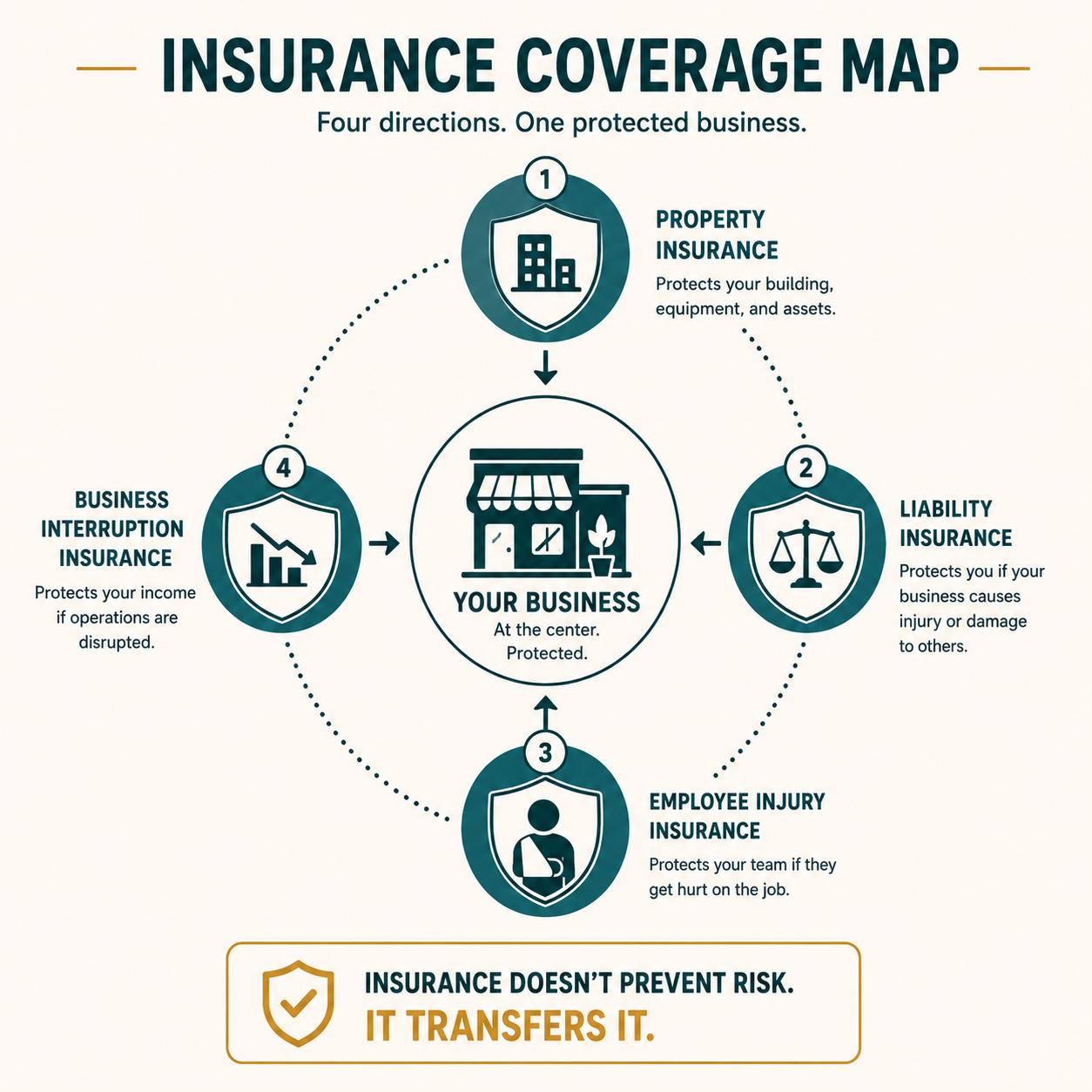
Fire, flood, theft of machines, stock, or premises.
A customer or third party harmed by the business.
A staff member hurt while performing their job.
Often mandatoryLost income while rebuilding after a covered event.
| Type | Covers | Cross-Reference |
|---|---|---|
| Property | Fire, flood, theft of machines, stock, or premises | Volume 04, Chapter 6: Asset Register (what to insure) |
| Liability | A customer or third party harmed by the business (an injury, a defective product) | Volume 08, Chapter 4: Threats |
| Employee injury | A staff member hurt while performing their job | Volume 06: People & Roles |
| Business interruption | Lost income while rebuilding after a covered event (fire, major equipment failure) | Volume 07, Chapter 14: Emergency Fund (the gap insurance doesn't fully close) |
Which insurance types are legally required (as opposed to merely wise) varies by country and industry, employee injury cover, in particular, is mandatory in many countries. Confirm requirements and available products with a licensed local insurance professional.
| Insurance | Emergency Fund | |
|---|---|---|
| Best for | Large, rare, potentially catastrophic losses | Smaller, more frequent cash-flow gaps |
| Cost | Ongoing premiums, whether or not a claim is ever made | The earnings given up by leaving that cash idle |
| Payout | Only for covered events, after a claims process | Immediately available, no restrictions beyond your own policy (Volume 07, Chapter 14) |
Most well-protected businesses use both: insurance for the catastrophic, rare risks that could otherwise end the business entirely, and an emergency fund for the smaller, more frequent shocks that don't justify a claim.
Here's the full version of the fire story from the start of this chapter.
The same electrical fire from Volume 04, Chapter 6's story also triggered a business interruption claim, covering lost income during the weeks the workshop was unusable while repairs were made. Without that specific coverage, the emergency fund alone would have had to cover both the physical loss and months of lost income simultaneously, a combination large enough to have seriously threatened the business's survival. The property claim and the interruption claim together did what no reserve fund alone could have done at that scale.
| Business | A Particularly Important Coverage for Them |
|---|---|
| Rapid Auto Works | Liability cover for damage to a customer's vehicle while in their care |
| City Kitchen | Product liability for food safety incidents |
| Green Fields Farm | Crop or weather-related loss coverage |
An emergency fund sized for a bad month, not for a catastrophic loss, see Section 3's comparison.
Insuring machines for their original purchase price rather than current replacement value, per Volume 04's asset register.
A policy sized for a one-workshop business doesn't automatically cover a second location or additional machines, review coverage whenever the business changes significantly.
Review your current insurance coverage (if any) against the four types in Section 2. For each gap, decide: insure it, reserve against it (Volume 07, Chapter 14), or accept the risk deliberately.